

Discover the wonders of Sri Lanka’s Cultural Triangle with a customizable tour of Anuradhapura, Polonnaruwa, and Sigiriya. Explore ancient ruins, temples, and natural landscapes in this historic region.
Discover the wonders of Sri Lanka’s Cultural Triangle with a customizable tour of Anuradhapura, Polonnaruwa, and Sigiriya. Explore ancient ruins, temples, and natural landscapes in this historic region.
UNESCO World Heritage Site - Anuradhapura
Mihintale - The tranquil ruins of Mihintale are intimately linked with the initial introduction of Buddhism to Sri Lanka. A ceremonial staircase ascends past pools, monastery ruins, and rock inscriptions to reach two large dagobas. As the climb takes about 25 minutes, it is advisable to visit early in the…
UNESCO World Heritage Site - Anuradhapura
Mihintale - The tranquil ruins of Mihintale are intimately linked with the initial introduction of Buddhism to Sri Lanka. A ceremonial staircase ascends past pools, monastery ruins, and rock inscriptions to reach two large dagobas. As the climb takes about 25 minutes, it is advisable to visit early in the morning or late in the afternoon to avoid the midday heat. Mihintale is not only a historical site but also a place for bird watching. It offers good access and moderate walking/climbing time. Key attractions include Mihintale Temple, Buddha statue, Cela Chaityaya, Aradhana Gal, and Kaludiya Pokuna.
Ruwanwelisaya - Revered by Buddhists worldwide, the Ruwanwelisaya is a stupa renowned for its architectural significance. Constructed by King Dutugemunu, celebrated for his victory over the Chola King Elara, it stands as one of the world’s tallest monuments at 300 feet (91 m) with a circumference of 950 ft (290 m).
Sri Maha Boodhi Temple - The sacred bodhi tree is central to Anuradhapura both spiritually and physically. Grown from a cutting brought from Bodhgaya in India, it is considered the oldest historically authenticated tree in the world, cared for by an unbroken line of guardians for over 2000 years. Today, thousands of devotees visit to make offerings, especially on poya (full moon) days and weekends. Sunset is a particularly enchanting time to visit.
Abhayagiri Dagaba - Dating back to the 1st century BC, this enormous dagoba was the ceremonial center of the 5000-strong Abhayagiri Monastery. Originally over 100m high, it was one of the ancient world’s greatest structures, its scale rivaled only by the pyramids of Giza (and nearby Jetavanarama). Today, after several reconstructions, Abhayagiri Dagoba rises 75m above the forest floor. Visually stunning, the first sight of this brick monument through a gap in the surrounding forest is breathtaking.
First city of the land in the 11th Century- Polonnaruwa
Gal Vihara - This remarkable group of statues was created by King Parakramabahu (1153-1186) as part of the Uthararama Complex.
The first statue encountered is a seated Buddha in meditation, positioned on a lotus. The rock behind the statue is adorned with carvings of “vimana,” featuring four smaller Buddha statues.
Next is a smaller Buddha statue (approximately 15 feet high) carved into the rock, flanked by two deities. It is believed this carving represents the Buddha’s visit to the heavenly realm “Thusitha” to preach to his mother.
It is said that this statue was once painted with pure gold, and treasure hunters burned logs on the statue to melt the gold.
The third is a standing Buddha statue. Some dispute its identity, suggesting it may represent Ananda Thero at the site of Lord Buddha’s passing. This 23-foot-tall statue is thought to have been created by a later king, as chronicles mention only two seated statues and one reclining statue by King Parakramabahu (1153-1186).
The final statue is a massive depiction of Buddha’s passing, measuring 80 feet long. The ear lid falling along the body and one foot slightly behind the other (with toes not aligned) indicate this is not Lord Buddha resting but at his death.
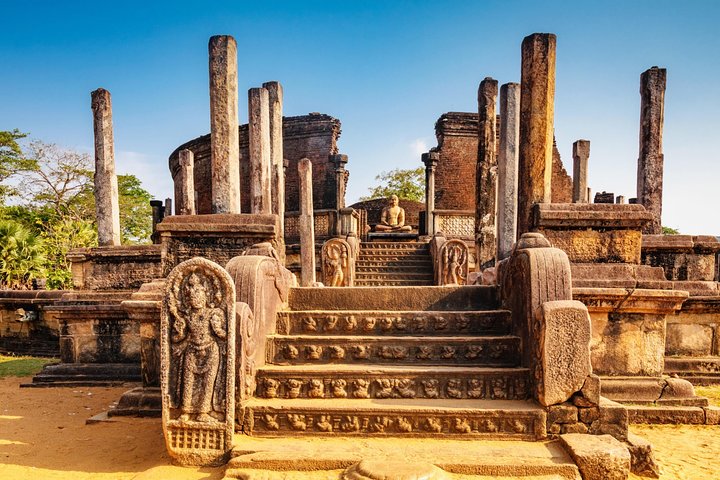
Polonnaruwa Vatadage - The Vatadage, one of Polonnaruwa’s oldest and most beautiful monuments, is located to the left upon entering the Dalada Maluwa. Despite its modest size, the circular building with concentric terraces is a masterfully planned and executed 12th-century masterpiece. It was intended to house the Sacred Tooth Relic of Buddha, now kept at The Sacred Temple of Tooth in Kandy, built by King Parakrambahu.
Lankathilaka Image House - This structure is notable for its two pylons at the entrance and the giant Buddha statue inside. The statue stands 42 feet tall, while the building walls reach 53 feet. Constructed with bricks, the structure had two floors, and remnants of stairs used to access the upper floor can still be seen.
Visit largest elephant gathering and King palace of Kassapa (Lion’s rock)
Minneriya National Park - Minneriya National Park is one of the premier locations in the country to observe wild elephants, often seen in large numbers. Elephants, sometimes numbering 200 or more, gather to feed and bathe during what is known as ‘the Gathering’. Flocks of birds, including little cormorants, painted storks, herons, and large pelicans, fish in the shallow waters.
Sigiriya The Ancient Rock Fortress - Rising dramatically from the central plains, the enigmatic rocky outcrop of Sigiriya is perhaps Sri Lanka’s most striking sight. Near-vertical walls ascend to a flat-topped summit containing the ruins of an ancient civilization, believed to have been the heart of the short-lived kingdom of Kassapa, offering breathtaking views across mist-covered forests in the early morning.

- Private transportation
- In-vehicle air conditioning
- Surcharges on fuel
- Parking fees
- Private transportation
- In-vehicle air conditioning
- Surcharges on fuel
- Parking fees
- Meals
- Accommodation(Hotels)
- Meals
- Accommodation(Hotels)
Most of tourists struggling to choose where to visit in Cultural triangle!
In the north-central area of Sri Lanka, dry plains and rocky outcrops are home to the famous Cultural Triangle. This region, the home of ancient Sinhalese royalty is loaded with ancient ruins and restored temples, a must visit when in Sri Lanka. The way in which The Cultural…
Most of tourists struggling to choose where to visit in Cultural triangle!
In the north-central area of Sri Lanka, dry plains and rocky outcrops are home to the famous Cultural Triangle. This region, the home of ancient Sinhalese royalty is loaded with ancient ruins and restored temples, a must visit when in Sri Lanka. The way in which The Cultural Triangle is experienced will be very different in terms of how much time is spent there.
Why a triangle?
The Cultural Triangle is so called because it includes three major sites that form a triangle. Anuradhapura to the north, Polonaruwa to the east and Kandy to the south-west.
Ancient Kingdoms, Ancient capitals, Dagobas, Sculptures, A Holy Tree, Cave Temples,Tanks, Rocky outcrops and many more to visit.
So we have design this tour as a tailor made where you can customize it on your preferences. Basically added top attractions in Anuradhapura, Polonnaruwa and Sigiriya/Dambulla. However you can extend this tour to Kandy on your request.
For a full refund, cancel at least 24 hours before the scheduled departure time.
For a full refund, cancel at least 24 hours before the scheduled departure time.


