Experience Lebanon’s cultural heritage with our Daily Tours of Beirut, Beiteddin, and Deir El Qamar. Wander through the lively streets of Beirut, explore the historic allure of Beiteddin, and admire the enduring beauty of Deir El Qamar. Embark on a journey rich in history, breathtaking architecture, and mouthwatering Lebanese cuisine.
Experience Lebanon’s cultural heritage with our Daily Tours of Beirut, Beiteddin, and Deir El Qamar. Wander through the lively streets of Beirut, explore the historic allure of Beiteddin, and admire the enduring beauty of Deir El Qamar. Embark on a journey rich in history, breathtaking architecture, and mouthwatering Lebanese cuisine.
- Pigeon Rocks in Raouche - The Pigeon Rocks are a breathtaking pair of rock formations and a popular tourist attraction, celebrated for their iconic shapes in a scenic seaside setting, welcoming visitors to Beirut. Known as the Rock of Raouché, these formations are located at the westernmost point of Beirut, standing like colossal guardians of the…
- Pigeon Rocks in Raouche - The Pigeon Rocks are a breathtaking pair of rock formations and a popular tourist attraction, celebrated for their iconic shapes in a scenic seaside setting, welcoming visitors to Beirut. Known as the Rock of Raouché, these formations are located at the westernmost point of Beirut, standing like colossal guardians of the city.
- Corniche El Manara, Ain El Mraiseh, Beirut - Extending from the Ramlet al Bayda area to the Saint George marina, Al Manara Corniche is Beirut’s most famous seaside promenade. Adorned with palm trees, it offers stunning views of the Mediterranean Sea, including the renowned Pigeon Rock and the peaks of Mount Lebanon to the east.
- Zaitunay Bay - Described as “Beirut’s finest leisure destination” on its official website, Zaitunay Bay is a modern waterfront promenade featuring shops and restaurants.
- Holiday Inn Hotel - This abandoned Holiday Inn Hotel is a significant war landmark in Beirut. Constructed between 1971 and 1974 during Beirut’s economic boom, it was a top tourist destination in the Middle East. The hotel operated until the Lebanese civil war began in 1975, becoming a “war zone” during the “Battle of the Hotels,” where over 25,000 combatants fought for control of luxury hotels, including the Holiday Inn and the famous Phoenicia hotel. The hotel remains untouched and empty decades after the war, serving as a reminder of the horrors of war to the Lebanese people.
- Mohammad Al-Amin Mosque - The Mohammad Al-Amin Mosque, also known as the Blue Mosque, is the largest mosque in Lebanon, located in downtown Beirut. This grand amber-colored mosque near Martyrs’ Square opened in 2008 and features four minarets standing 65 meters high. The mosque has multiple domes made from light blue tiles and several arches that are a couple of stories high.
- Al-Omari Mosque - The Al-Omari Grand Mosque was originally built during the era of Omar Bin El Khattab in 635 AD and later converted to the Church of Saint John by the Crusaders in the 12th century. It was transformed back into the city’s Grand Mosque by the Mamluks in 1291. Damaged during the Civil War, the mosque’s restoration was completed in 2004.
- Greek Orthodox Cathedral of Saint George - The Greek Orthodox Cathedral of Saint George is the seat of the Greek Orthodox Metropolitan bishop of the Greek Orthodox Archdiocese of Beirut and its dependencies. It is the oldest church in Beirut and one of the oldest in the region, located in the heart of Beirut’s city center. The first Christian temple on this site dates back to the mid-sixth century AD and is closely associated with Beirut’s famous Law School.
- Martyr’s Square - Martyrs’ Square is a central square in downtown Beirut, historically known as “Al Burj” or “Place des Cannons.” It is named after the executions of Lebanese nationalists by the Ottomans on May 6, 1916, ordered by Jamal Pasha during World War I.
- Place de l’Etoile - Nejme Square, or Place de l’Étoile, is the central square in the Downtown area. It houses the Lebanese Parliament and its complementary buildings, two cathedrals, a museum, and several cafes and restaurants. Notable for its 1930 four-faced Rolex clock and architecture, the square has become a recognizable icon of Beirut City worldwide.
- Beirut Souks - Beirut Souks is a commercial district in Beirut City Center, featuring over 200 shops, 25 restaurants and cafes, an entertainment center, and a cinema complex. Beirut Souks is the largest and most diverse shopping and leisure area in Beirut.
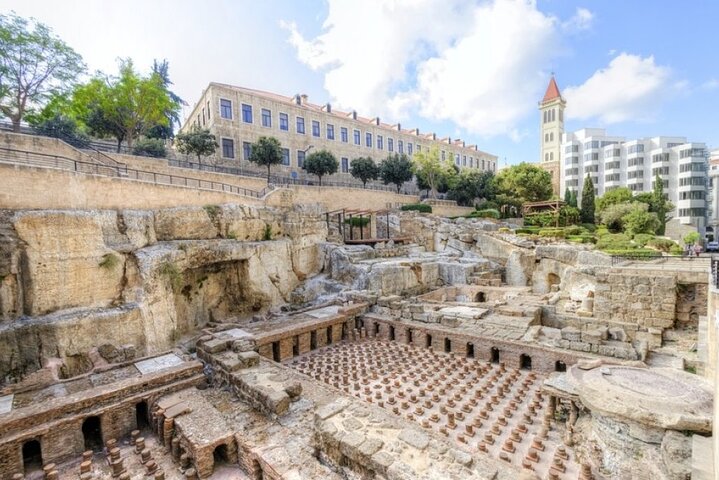
- Roman Baths - The Roman Berytus baths are the largest outdoor site located in downtown Beirut. Discovered in 1968-1969, they underwent major renovation in the mid-1990s. Roman Berytus had four major bath complexes, with the first created in the early first century under Augustus. The devastating Berytus earthquake in 551 AD destroyed all the baths. Today, the Roman Berytus Baths reflect the ancient traditions of the site, with one bath used as an artistic performance and concert space.
- Beiteddine Palace - Beiteddine Palace, or ‘House of Faith,’ is a 19th-century palace in Beiteddine, Lebanon. It hosts the annual Beiteddine Festival and the Beiteddine Palace Museum. Emir Bashir Chehab II, who later became the ruler of the Mount Lebanon Emirate, built the palace between 1788 and 1818. After 1840, the palace was used by the Ottomans as a government building. During the French Mandate, it served as a local administrative office. In 1943, the palace was declared the president’s official summer residence. During the Lebanese Civil War, it was heavily damaged. Parts of the palace are open to the public today, while the rest remains the president’s summer residence.
- Deir el Qamar - Deir al-Qamar, meaning “Monastery of the Moon,” is a village located southeast of Beirut and five kilometers outside of Beiteddine Palace in the Chouf District of Mount Lebanon. Deir El Qamar was the first village in Lebanon to have a municipality in 1864 and is the birthplace of many well-known personalities, such as artists, writers, and politicians. People from all religious backgrounds lived there, and the town had a mosque, synagogue, and Christian churches. In 1860, Deir al-Qamar was destroyed during the civil war between Druze and Christians, during which the town was set ablaze. Napoleon III sent a French contingent to rebuild it, recalling France’s ancient role as protector of Christians in the Ottoman Empire, established by a treaty in 1523. In 1864, Deir el-Qamar elected the first municipality in the Arab provinces of the Ottoman Empire. The village retains a picturesque appearance with typical stone houses with red tile roofs.
- Fakhreddine’s Mosque - Fakhreddine Mosque, with its octagonal minaret, is a mosque in Deir el Qamar, Lebanon. Built in 1493 and restored in the sixteenth century by Fakhreddine I, it is the oldest mosque in Mount Lebanon.
- Saydet El Talle Church - The Church of Saidet et Tallé, translated as Our Lady of the Hill, is one of the most important historical and religious sites in Deir el Qamar, dating back to the 15th century. Monk Nicolas Smisaati built a church on the site over the ruins of an old Phoenician temple dedicated to the goddess Astarte, which was later destroyed by an earthquake in 859. According to the Maronite Heritage website, “the legend says that there was a Druze Emir in Baakline looking at the hill of Dar El Kamar. He saw a light coming out of the hill, so he gathered his soldiers and ordered them to go in the morning and dig in the land. He said to them: ‘If you find an Islamic symbol, build a mosque. If you find a Christian symbol, build a church.’ In the morning, the soldiers went and found a rock with a cross on it, and under the cross, there was the moon and Venus. That was the sign that in the distant past, there was a temple dedicated to the moon and Venus, and later it became a church.”

- Lunch
- Hotel Pick up & Drop off
- Small group sizes
- In-vehicle air conditioning
- Professional, knowledgeable guides
- Lunch
- Hotel Pick up & Drop off
- Small group sizes
- In-vehicle air conditioning
- Professional, knowledgeable guides
- Gratuities
- Entrance fees
- Gratuities
- Entrance fees
For a full refund, cancel at least 24 hours before the scheduled departure time.
For a full refund, cancel at least 24 hours before the scheduled departure time.