Exploring East Berlin: A Historian’s Perspective on the Wall and Beyond
As a historian and travel writer, I was drawn to Berlin’s complex past and the opportunity to explore it through the East Berlin History Tour. Join me as I recount my journey through the city’s hidden stories and architectural echoes.


A Journey Through Time: East Berlin’s Hidden Stories
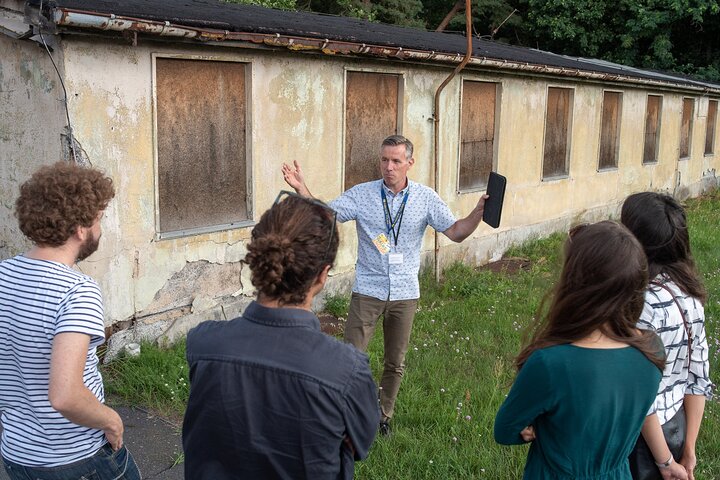
Berlin, a city that has long fascinated me with its complex history and architectural marvels, offered yet another layer of intrigue during my recent visit. This time, I embarked on the East Berlin History Tour led by the charismatic Paolo, whose theatrical storytelling brought the past to life in a way that resonated deeply with my own passion for history.
The Ghost Stations and the Wall
Our journey began at the bustling Potsdamer Platz, where we were greeted by Paolo and his unmistakable blue bicycle. As we ventured into the heart of East Berlin, Paolo’s vivid descriptions painted a picture of a city divided by ideology and concrete. At the Berlin Nordbahnhof, we delved into the eerie world of ghost stations—subway stops that were sealed off during the Cold War, leaving them as silent witnesses to a divided city.
Standing at the Memorial of the Berlin Wall, I was struck by the stories of those who risked everything to escape to the West. Paolo’s narrative was rich with detail, capturing the tension and desperation of a time when the Wall was more than just a physical barrier; it was a symbol of a fractured world. His ability to convey the emotional weight of these stories was nothing short of remarkable, and it reminded me of the power of history to connect us to the human experience.
Architectural Echoes of the GDR
As we moved towards Alexanderplatz, Paolo’s insights into the German Democratic Republic’s architecture were both enlightening and thought-provoking. The stark, utilitarian design of the buildings stood in contrast to the vibrant life that now fills the square. Here, Paolo recounted the great popular manifestation that took place, a pivotal moment that contributed to the Wall’s eventual fall.
The towering Berliner Fernsehturm loomed above us, a relic of the GDR’s ambition and a testament to the era’s architectural prowess. Though we only admired it from the outside, its presence was a constant reminder of the city’s layered history. Walking along Karl-Marx-Allee, I was transported back to the Stalinist era, with its grand boulevards and imposing structures that spoke of a time when architecture was a tool of political expression.
Art and Freedom at the East Side Gallery
Our final stop was the East Side Gallery, where the remnants of the Berlin Wall have been transformed into a canvas of freedom and expression. The murals, vibrant and defiant, told stories of hope and resilience. As an admirer of art’s ability to capture the essence of a moment, I found this part of the tour particularly moving.
Paolo’s passion for Berlin’s history was infectious, and his ability to weave together the city’s past and present left a lasting impression. This tour was more than just a walk through history; it was an exploration of the human spirit and the enduring power of hope. For anyone seeking to understand Berlin beyond its more famous narratives, the East Berlin History Tour offers an invaluable perspective.