


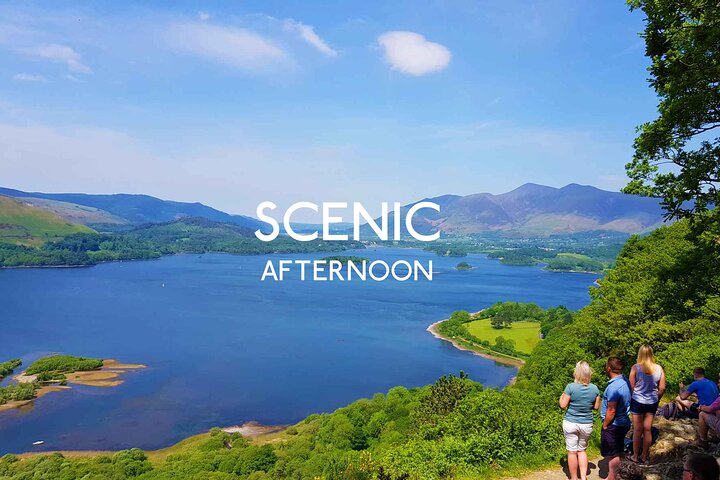
Experience the majestic scenery of the Lake District on the 8 Lakes Tour. This stress-free half-day tour allows you to soak up the views, paddle in a lake, and learn about the area’s culture and history. Join us for a comfortable and informative adventure!
Experience the majestic scenery of the Lake District on the 8 Lakes Tour. This stress-free half-day tour allows you to soak up the views, paddle in a lake, and learn about the area’s culture and history. Join us for a comfortable and informative adventure!
- Kirkstone Pass - As you ascend and navigate the twists of this road, you’ll find yourself on the highest road in the Lake District, renowned for its breathtaking views. Along the way, you’ll pass through stunning mountain landscapes, pausing at the summit near the historic Kirkstone Pass Inn to take in the expansive vistas. The fresh air is…
- Kirkstone Pass - As you ascend and navigate the twists of this road, you’ll find yourself on the highest road in the Lake District, renowned for its breathtaking views. Along the way, you’ll pass through stunning mountain landscapes, pausing at the summit near the historic Kirkstone Pass Inn to take in the expansive vistas. The fresh air is invigorating, and the view down the long valley towards the shimmering Windermere Lake is spectacular. On clear days, you might even catch a glimpse of Morecambe Bay. Look around to spot the native Herdwick sheep among the impressive dry-stone walls and observe hikers appearing as tiny colorful dots on ancient trails high on the surrounding hillsides. As you descend the other side of the pass, you’ll have another chance to capture stunning photos of the wide valley with the road winding towards Brothers Water.
- Ullswater Lake - Stretching nearly eight miles, Ullswater is the second longest lake, with a dramatic serpentine shape framed by towering fells, none higher than the challenging Helvellyn. The shores are adorned with oak, birch, and hazel woods, showcasing pre-plantation Lakeland scenery. This is a truly special place. William Wordsworth described Ullswater as “the happiest combination of beauty and grandeur, which any of the Lakes affords,” and it’s hard to disagree.
- Castlerigg Stone Circle - Perched on a hill with a stunning panorama of majestic mountains, 48 stones stand here, placed over 5000 years ago. This is Castlerigg stone circle, once thought to be a Druid haunt by romantic Victorians. Its true purpose remains a mystery, but few stone circles in Britain boast such a dramatic setting. A short walk brings you into the circle itself, where you can absorb the atmosphere and marvel at the breathtaking views.
- Ashness Bridge - Taking a hidden single-track road, you’ll climb steeply for half a mile to an old dry-stone packhorse bridge. Ashness Bridge, with its fast-flowing stream, is one of the most photographed spots in the Lake District. It offers a view across Derwentwater to the towering Skiddaw peaks above Keswick, making it a “must-do” photo stop.
- Surprise View - Few views surpass this one. Perched high on an oak-lined cliff edge, you’ll enjoy one of the finest views in the Lake District. Surprise View is a true gem, offering stunning panoramic vistas across Derwent Water to the Skiddaw mountain range, Borrowdale Valley, Keswick, Bassenthwaite Lake, the Solway, and even the distant shores of Scotland on a clear day. The photo opportunities are fantastic!
- Lake Grasmere - Nestled in the Vale of Grasmere, the lake is almost entirely encircled by graceful fells and forever linked with poet William Wordsworth. Here, William, his sister Dorothy, and brother John spent leisurely days swimming and fishing for pike. They would row to the island for summer picnics and stroll its shores, soaking in the sights and sounds, lying in the grass listening to the wind in the trees and the echoes of bird calls. Today, you’ll still see people wild swimming and colorful rowboats bobbing along. Not much has changed here.
- Rydal Water - From the road, you’ll enjoy great views of this reedy little lake, one of the prettiest on a summer morning or even a frosty winter day. In autumn, it glows with shades of gold and orange on misty days, taking your breath away. Smaller than its neighbor at just ¾ mile long, ¼ mile wide, and 50ft deep, it was a favorite of the Wordsworth family and is often mentioned alongside Grasmere. As you drive along the shore, pay attention to the rocky knoll with steps leading to Wordsworth’s seat, his favorite spot to gaze upon the often glass-like lake and its shores. Rydal Water was originally called “Rothaymere,” meaning “the lake in the valley where the rye is grown,” and it hosts a thriving population of wildfowl. Gulls roost along the shoreline, and if you’re lucky, you might spot red squirrels in the larches or native Herdwick sheep in the pastures.
- Bridge House - You won’t believe the story of the family who lived in this tiny cottage. It has a long and varied history, as you’ll hear when we slow down for a quick photo and pass the famous Bridge House in the heart of Ambleside. One of the most photographed buildings in the Lakes, it’s a delightfully quirky, 300-year-old house that straddles the clattering brook of Stock Ghyll.
- Lake Windermere - You can’t miss this one, England’s largest and most visited lake, which rarely fails to impress. Named after a Norse hero, Windermere is the most famous of them all and has attracted visitors for nearly 300 years. From its rocky inlets, secluded bays, grassy banks, and wooded heights to the northern skyline with volcanic peaks and the southern shore heavily wooded with broadleaf trees, Windermere embodies the Lake District’s iconic image. Listen to your guide to learn about its creation, the Romans’ activities here, the arctic fish that call the lake home, boats, and why the local “boggle” stopped the ferry from running at night.
- Windermere - One of the pick-up locations for this tour - we meet outside the railway station entrance. Windermere village is largely a product of the Victorian railway’s arrival in the Lake District. Many original villas and guest houses still stand, making this village the central Lakes’ transport hub. Just as in Victorian and Edwardian times, day-trippers and holidaymakers arrive in Windermere by train, which terminates here. There’s no shortage of accommodation or dining options. If you’re joining the tour here, you’ll soon discover why the village changed its name, why William Wordsworth was upset about the railway, and why the lake of the same name is a mile or so down the hill.
- Bowness-on-Windermere - One of our pick-up points for this tour - we meet outside Pier 1 by the lake shore. Bowness is a lively, bustling place with large and small hotels, bed and breakfasts, and numerous cafes, bars, and restaurants. The settlement is much older than nearby Windermere, with narrow streets clustered behind the parish church dating back over 300 years. If you’re staying here, you’ll find the village’s history condensed into this small area, with cottages once inhabited by boatmen and fishermen. Ancestors of George Washington had their coat of arms included in the church window, and Charles Dickens stayed at the famous “Hole in t’Wall” inn. A short stroll along the promenade brings you to the village’s boating area, where you can sail big boats up and down the lake, hire small boats to explore islands and inlets, or enjoy tiny rowing boats on the lake.
- Ambleside - Surrounded by fells, Ambleside is described as “the hub of the wheel of beauty,” sitting at the heart of the southern lakes with roads radiating into the central valleys. As you pass through the town center, you’ll see the legacy of the Victorian tourist boom in the splendid slate buildings crafted by local artisans and the tiny Bridge House over the clattering Stock Ghyll stream. You’ll hear about the Roman fort, Galava, built on Windermere Lake’s shores, and discover why the spired parish church features a mural celebrating the town’s oldest custom, Rushbearing. This bustling town offers a glimpse into life here, where nature, landscape, and weather still impact 21st-century lives, and how its famous residents attracted the first tourists over a century ago.
- Coniston - Near one of our pickups
- Kendal - Near one of our pickups
- Cartmel - Near one of our pickups
- Ulverston - Near one of our pickups
- Newby Bridge - Near one of our pickups
- Grange-over-Sands - A short drive from our pickup in Windermere
- Flookburgh - If staying here, why not join this tour at Windermere?
- Scarborough - a test
- Dockray Hall Industrial Estate - our home base
- Brothers Water - This small lake may have once been connected to the larger Ullswater lake further down the valley, which is filled with dramatic scenery. Around the western shore, the path dips under the canopy of some of the oldest oak woodland in the Lake District. However, it’s the tragic tale of two brothers that gives this little body of water its romantic name.
- Derwentwater - Just south of Keswick, you’ll find Derwentwater, shimmering and sparkling. Dotted with islands and craggy fells, it’s undoubtedly one of our prettiest lakes. Known as “the Queen” of the English Lakes, a drive along its shoreline offers glimpses of the evocatively named Cat Bells and views towards the dramatic Jaws of Borrowdale. You’ll hear tales of hermits, hedgehogs, squirrels, and mock sea battles, all part of this enchanting lake’s history and folklore.
- Bassenthwaite Lake - From Surprise View, you’ll see Bassenthwaite sparkling in the distance. It’s the northernmost of the major water bodies, with its shoreline being the best protected in the National Park due to its rich variety of plants and animals. Over seventy bird and wildfowl species winter and breed here, including magnificent ospreys. It’s also one of the few places in Britain where the vendace, a nine-inch fish related to other Arctic species, is found.
- Thirlmere - As you travel south along Thirlmere’s tree-fringed shores, you’ll hear the poignant tale of the villages of Armboth and Wythburn, now submerged beneath these waters. The story is one of wealth, industry, and the might of Manchester, which crushed the rural lifestyle of these villagers in the 19th century. Beautiful and tranquil, Thirlmere is backed by the mighty Helvellyn, once a favorite walking spot for Wordsworth and his friends. It’s also a place of legend, with tales of hauntings and spectral black dogs. Fortunately, you’re safe in the van and not visiting after dark!
- Blencathra [Saddleback] - As you approach Keswick, the road is dominated by the mountain known as Blencathra. This name means “Saddleback” in the ancient Cumbric language, and from a distance, she resembles one. In summer, she wears a purple heather mantle, while in winter, she often dons a snowy cap. As you get closer, you’ll hear more about her history and the intriguing tale of an Earl and the Lordship of a Manor in 2014. Standing at 2,848ft, this mountain has six separate fell tops and is part of the Skiddaw range, some of England’s oldest rocks at roughly 500 million years old. If you look closely, you might spot the distinctive ridge known as Sharp Edge, an aptly named arête offering one of the area’s most famous scrambles. “The crest itself is sharp enough for shaving (formerly called razor edge) and can be traversed only a cheval at some risk of damage to tender parts.” Not for the faint-hearted!
- Helvellyn - If you suffer from vertigo, you’ll be relieved to pass by Helvellyn in a comfortable air-conditioned mini-van without having to climb. This is the third highest peak in the Lake District, popular year-round with experienced walkers, especially the classic ridge route along Striding Edge, which is challenging with dizzying drops and some all-fours scrambling. As you relax and enjoy the scenery, spare a thought for the Helvellyn Weather Assessors who climb the mountain daily between December and March to assess avalanche risks and record conditions like wind chill, snow depth, and temperature. You’ll also learn that it was Wordsworth’s favorite mountain and hear the touching story of a romantic artist and his faithful dog Foxie, immortalized by Wordsworth in his poem “Fidelity” (Spoiler – Foxie survives. Yay!)
- Wordsworth Grasmere - Dove Cottage. William Wordsworth discovered this tiny cottage during a walking tour of the Lake District. It’s a richly evocative place, especially for poetry lovers. He lived here contentedly with his sister Dorothy, wife, and children while writing his famous poems. You’ll be able to snap a quick photo of this famous little whitewashed house as we pass by.
- The Grasmere Gingerbread Shop - We stop here; we must. There would be a rebellion on the bus if we didn’t, so don’t worry, you’ll have time to get that delicious, irresistible, gingery treat everyone loves. Created in 1854, only a handful of people know the secret recipe for this unique, spicy-sweet cross between a biscuit and cake. When you enter the shop, you’ll be greeted by the wonderful aroma of freshly baked Grasmere Gingerbread. But it doesn’t stop there; the shop also sells its own award-winning rum butter and a variety of ginger-themed goodies, as well as toffee, fudges, chocolates, conserves, Cartmel Village Store Sticky Toffee Sauce, Kendal Mint Cake, conserves, ginger beer, ginger-themed gifts, and much more. Just one thing, though, please don’t feed the drivers and guides; we’ve only just managed to wean them off it all!
- Grasmere - Stopping here, you’ll find a couple of narrow roads leading to a tiny village green, a cluster of handsome grey-stone buildings, and a scatter of traditional whitewashed cottages. This is Grasmere, an archetypal Lake District village. Look up, and all around you’ll see the ring of mighty fells surrounding the Vale of Grasmere, lovingly cradling this snug little village. At its heart, you’ll find the ancient church, much as it did in Wordsworth’s time, still nestled beside the babbling river Rothay. We don’t stop here for long, but you’ll quickly discover that it truly is as William Wordsworth described it, “The loveliest spot that man hath ever found.” He should know; he lived here for over a decade, returning to be buried in this serene, English country churchyard dotted with yews and ivy-strewn monuments. Literary and gingerbread pilgrims flock here to pay their respects and purchase the famous local tasty treat.
- Rydal - As you pass through this tiny hamlet steeped in history, you’ll discover where William Wordsworth lived for 37 years, the church where he was warden, who “Dora” is, and what makes the Badger Bar special. It’s hard to believe so much happened here in such a sleepy spot!
- Oxenholme Station - Timed to meet the early morning train from London, this is one of the tour’s pick-up locations – we meet outside the ticket office. Oxenholme is the Lake District railway station on the West Coast Main Line, running from London to Glasgow, where day-visitors to the Lake District arrive for our tours. If you’re not catching the branch line train to Windermere or staying in the Lakes, it’s a convenient location to join one of our full-day tours. If you decide to stay close to the station, there’s a guest house and a small hotel within easy walking distance. If you’re meeting us by car, there’s a car park at the station with a flat rate of £12.00 per day. While waiting for a return train home, you can get refreshments at Willans shop, located next to Oxenholme Lake District Railway Station, offering a wide variety of products, many made on-site.
- Troutbeck - As you climb the winding road from Windermere’s shores, passing elegant Victorian mansions, you’ll notice the lake view changes significantly. You’ll have a quick photo stop to hear about the lake itself and look down on it across the rolling green fields and broadleaf woodland of nearby farms. You’ll fall in love with this tiny village, strung out along the valley side above the Trout Beck (stream) from which it gets its name. One of its most striking features is the fine selection of traditional Lakeland buildings, most dating from the 17th century. As you pass through the village, you’ll hear about Townend, a National Trust property preserved like a time capsule, telling the story of the Brown family who lived here from 1626 for over 400 years. If you gaze across the valley, you’ll start to see the countryside change as we head higher, becoming more bleak and remote as you move into the mountains. Beatrix Potter once had a farm here.
- Patterdale - Nestled in the valley at Ullswater’s south end, you’ll see this village is a small cluster of buildings hugging the roadside with two pubs, a youth hostel, and a mountain rescue base. There used to be a shop, but it has recently been sold, and we’re all waiting to see what happens next. That’s how small the village is! The saint’s church at the northern end of the village replaced the medieval original in the 19th century and is known for the locally made embroidered tapestries inside, created by an artist with the surname of a Shakespeare play. This is walking territory, and several good walks start from this village into the high fells surrounding it. As you pass through, you’ll hear about a local breed of dog, a well-known patron saint, and a spring once thought to have healing properties.
- Glenridding - As you travel along the leafy road past farms and pastures, you’ll suddenly catch your first exciting glimpse of Ullswater and its fleet of historic steamers as we enter the village. For centuries, this was a busy mining valley, but you’ll find no trace of it now. Lead was discovered in the area in the 17th century, and mining peaked in the early 19th century, with Greenside, hidden among the fells, being one of the best lead mines in the country. The mine closed in 1962, and now the village is a bustling place with shops and cafes filled with walkers and hikers. There are also some classy hotels here with grounds stretching to the lake’s edge. You’ll discover that one of them, formerly a Regency-era family villa, was visited by a famous scientist who stayed here for a week with his family and later wrote of his holiday, “This place is magnificently beautiful, and I enjoy the scenery.” We agree with him!
- Keswick - At the top of Derwentwater, Keswick is the northern tourist capital of the Lakes, filled with shops, cafes, bars, hotels, and Victorian guest houses. Despite the town’s genteel feel, mining was once the reason for Keswick’s existence. It began in the 16th century with expert miners from Germany who settled on Derwent Isle and were employed to find gold. They only found copper and other minerals. Later, as mining declined, tourism grew with the railway’s arrival in 1865. Wordsworth visited the town often, particularly to see his close friend and fellow Romantic Poet, Samuel Taylor Coleridge, who complained, “for two-thirds of the year we are in retirement…the other third is alive & swarms with Tourists of all shapes & sizes & characters.” You’ll find that not much has changed. As we drive through the town, you’ll see the Moot Hall, hear about a familiar poet who wrote about bears, the antics of saints, a unique museum, and what Keswick means in Old English.

- Relaxed and friendly small-group tour, max 7 guests
- Comfortable air-conditioned minivans with WiFi and charging points
- Regular stops for photos and comfort
- Professional guides sharing fascinating facts and stories in English
- Convenient central meeting points for departure and return
- All entrance fees included for itinerary locations
- Relaxed and friendly small-group tour, max 7 guests
- Comfortable air-conditioned minivans with WiFi and charging points
- Regular stops for photos and comfort
- Professional guides sharing fascinating facts and stories in English
- Convenient central meeting points for departure and return
- All entrance fees included for itinerary locations
- Food & drink
- Food & drink
Ideal scenic half-day excursion. Your later part of the day will be filled with visiting some of the most stunning landscapes in entire Lake District. This is a leisurely, effortless way to discover a large part of the Lake District in half-a-day without getting overwhelmed. You will have ample opportunity to enjoy the views and even dip your toes in a…
Ideal scenic half-day excursion. Your later part of the day will be filled with visiting some of the most stunning landscapes in entire Lake District. This is a leisurely, effortless way to discover a large part of the Lake District in half-a-day without getting overwhelmed. You will have ample opportunity to enjoy the views and even dip your toes in a lake if you’re adventurous. This is an excellent method to gain a general understanding of the Lake District, its tradition, history and, unmistakably, its breathtaking scenery.
You’ll experience diverse sights, bewitching landscapes, savor gingerbread, and obtain all the intriguing facts and statistics from our friendly and well-informed guides and drivers who are well-acquainted with the region.
Traveling in a cozy mini-van equipped with air conditioning, Wi-Fi, and phone charging ports, being one of just 6/7 passengers, you’ll find it convenient to ask questions and engage in discussions (only if you choose to). There are numerous stop-offs for photography and breathing in the fresh air. It’s a wonderful way to spend an afternoon, and we eagerly look forward to sharing it with you.
- The English Lake District weather can change quickly, even in the summer months. Please bring a waterproof coat with a hood in case of rain or windy weather
- As there is a little walking involved on the tour, some uphill and on uneven or wet terrain, please wear suitable, comfortable shoes
- No Children under the age of 7
- Children must be accompanied by an adult
- All passengers, including children of any age, must have a seat purchased for them
- We will collect you from the departure point linked to your chosen option. Please do not change to a different departure point without informing us in advance as we don’t automatically go to every departure point. If we don’t know you have changed your departure point we may not pick you up for the tour!
For a full refund, cancel at least 24 hours before the scheduled departure time.
For a full refund, cancel at least 24 hours before the scheduled departure time.


