


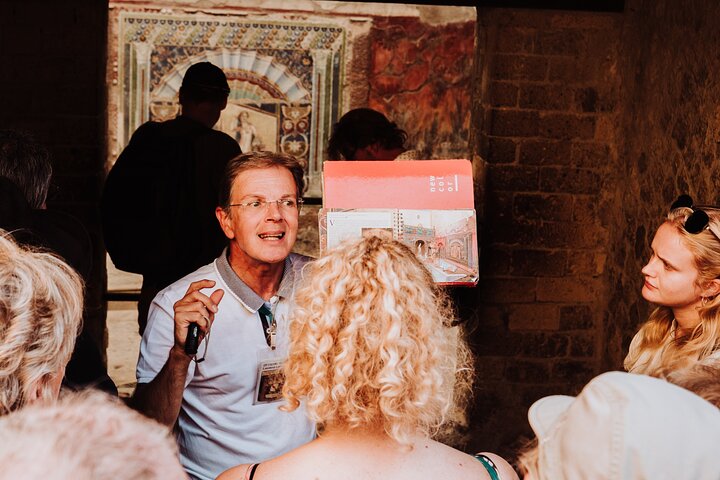

Immerse yourself in the ancient Roman city of Herculaneum on a small group tour with an archaeologist. Explore the well-preserved ruins and discover the dramatic history of this once-thriving city.
Immerse yourself in the ancient Roman city of Herculaneum on a small group tour with an archaeologist. Explore the well-preserved ruins and discover the dramatic history of this once-thriving city.
-
Parco Archeologico di Ercolano - The meeting point is at the Ticket Office of the Herculaneum ruins.
You can reach it by: - Car via Pignalver (There is an unguarded parking area very close to the meeting point)
- Train via Corso Resina 1 (The Circumvesuviana train station is a 10-minute walk away)
- House of the Deer - This house is named after…
- Parco Archeologico di Ercolano - The meeting point is at the Ticket Office of the Herculaneum ruins.
You can reach it by:
- Car via Pignalver (There is an unguarded parking area very close to the meeting point)
- Train via Corso Resina 1 (The Circumvesuviana train station is a 10-minute walk away)
- House of the Deer - This house is named after marble statues of deer found in the peristyle.
- La Terrazza di M. Nonio Balbo - M. Nonius Balbus was a major benefactor of the city, responsible for restoring and constructing many public buildings. Upon his death, he was honored as a patron with numerous accolades, as detailed in the lengthy inscription on his funeral altar.
- College of the Augustales - It is believed that this building served as a center for the cult of Emperor Augustus and the headquarters of the Collegium Augustalium (or possibly even the local curia).
- Casa del Rilievo di Telefo - This house likely belonged to one of the town’s leading benefactors, Marcus Nonius Balbus, and is unique in having its own private access to the adjoining Suburban Thermae to the south.
- Partem Domus lignea - Casa del Tramezzo di Legno - This house is significant for its elegant wooden partition that remains intact.
- House of the Skeleton - The House of the Skeleton, probably an amalgamation of three smaller buildings, gets its name from the discovery of human remains in a second-floor room in 1831.
- Central Thermae - The Central Thermae were constructed around the beginning of the 1st century AD and were divided, as was customary, into men’s and women’s baths, each with separate entrances.
- House of the Black Salon - The House of the Black Hall is one of Herculaneum’s more luxurious residences. It features a monumental entrance that still retains the carbonized remains of the doorposts and lintel.
- Casa Sannitica - This house has a layout typical of the Samnites (an ancient people of the Sabine race who inhabited this mountainous part of central Italy). The splendid atrium is bordered by a gallery with Ionic columns, and the rooms are adorned with frescoes.
- Casa del Bel Cortile - This is one of the most unique houses in Herculaneum. It features a courtyard with a stairway and a stone balcony instead of an atrium.
- House of the Grand Portal - A beautiful domus in the center of the archaeological area, with various rooms, colonnades, frescoes, and, as is common throughout Herculaneum, charred remains of wooden parts.

- Licensed guide with archaeological background
- Entrance fees
- Small Group (maximum 20 people per guide)
- Headsets
- Guidance and assistance
- Licensed guide with archaeological background
- Entrance fees
- Small Group (maximum 20 people per guide)
- Headsets
- Guidance and assistance
- Meals/drinks
- Private transportation
- Meals/drinks
- Private transportation
Experience the opportunity to explore the site of Herculaneum with the guidance of an Archaeologist.
Discover more about this ancient Roman city, once home to merchants and nobility, whose existence was abruptly ended in 79 AD. The guide will take you to the waterfront, where over 300 remains of people attempting to flee by sea were discovered, as well…
Experience the opportunity to explore the site of Herculaneum with the guidance of an Archaeologist.
Discover more about this ancient Roman city, once home to merchants and nobility, whose existence was abruptly ended in 79 AD. The guide will take you to the waterfront, where over 300 remains of people attempting to flee by sea were discovered, as well as the Samnite house, the thermal baths, the Temple of the Augustales, the forum, the house of Neptune and Amphitrite, the Gymnasium, the house of the wooden partition, and much more.
This will be an immersive experience: you will witness not only the stone, marble, and ceramics that remain, but also carbonized wood and even more exquisite paintings and mosaics than those found in Pompeii. Herculaneum was destroyed by a significantly more powerful force, which instantly incinerated all wood and buried the city under a thick layer that prevented air from causing decay.
- Confirmation will be received at time of booking
- Operates in all weather conditions, please dress appropriately
- Dogs are allowed at the Herculaneum Archaeological Park without breed or size restrictions, however they must be kept on a leash or muzzle and it is mandatory to have bags to collect any droppings. For reasons of logistics and conservation, within the Antiquarium premises, the Boat Pavilion, and the domus featuring mosaic floors, access is permitted only to dogs that are carried in arms or transported in an appropriate carrier.
- Herculaneum ruins’ entry tickets: 16 euros (adult) 2 euros (EU citizens 18-25 y.o.)
For a full refund, cancel at least 24 hours before the scheduled departure time.
For a full refund, cancel at least 24 hours before the scheduled departure time.


