Experience the beauty of Romania’s Transylvania and Bucovina regions on a 6-day private tour. Visit stunning painted churches, explore medieval castles and citadels, and stay in a rustic country house. Travel in luxury and make unforgettable memories.
Experience the beauty of Romania’s Transylvania and Bucovina regions on a 6-day private tour. Visit stunning painted churches, explore medieval castles and citadels, and stay in a rustic country house. Travel in luxury and make unforgettable memories.
Bucharest - Bucovina 450 Km - 6h
Humor Monastery - Humor Monastery stands as a religious gem in Bucovina, a region renowned for its numerous churches and monasteries. Recognized as a UNESCO World Heritage Site, along with the painted churches of Voronet, Sucevita, and Moldovita, Humor Monastery is nearly 500 years old. Its Byzantine frescoes…
Bucharest - Bucovina 450 Km - 6h
Humor Monastery - Humor Monastery stands as a religious gem in Bucovina, a region renowned for its numerous churches and monasteries. Recognized as a UNESCO World Heritage Site, along with the painted churches of Voronet, Sucevita, and Moldovita, Humor Monastery is nearly 500 years old. Its Byzantine frescoes remain rare and valuable to this day. Constructed in 1530 on the site of an older church, Humor Monastery features unique characteristics such as its smaller size and the absence of a steeple on its cross-shaped roof. These elements reflect the status of its founder, a wealthy high-ranking court official, though not a prince.
The name of Prince Petru Rares is inscribed alongside the founder, Toader Bubuiog, above the church entrance.
Voronet Monastery - Known as the ‘Sistine Chapel of the East’ for its magnificent frescoes, the church of Voronet Monastery was erected in just a few months in 1488 by Stephen the Great, Moldavia’s most celebrated prince, following a victory over the Ottoman forces. This was a common practice for the prince, who promoted the Moldavian architectural style. Many churches built in this style still stand today in Moldavia and Bucovina.
With its small yet well-proportioned structure, Voronet Monastery’s church exemplifies the Moldavian style, incorporating Gothic and Byzantine elements. From its inception, it served more than just a religious purpose. Its frescoes illustrated biblical moral stories for the illiterate villagers, encouraging them to follow Christian principles.
The frescoes of Voronet, showcasing the painters’ exceptional talent, hold a centuries-old secret. The unique ‘Voronet blue’ color is unmatched globally, and its composition remains nearly impossible to replicate today.
The 15th and 16th-century frescoes are the church’s main attraction, a masterpiece of Byzantine art.
Bucovina, Gura Humorului - Moldovita - Sucevita
Moldovita Monastery - Moldovita Monastery is one of eight painted churches included in the UNESCO World Heritage Sites, all masterpieces inspired by 15th and 16th-century Byzantine art. Their unique feature – external walls adorned with frescoes depicting complete religious cycles – sets them apart from other churches worldwide from that era.
Continuing his father’s legacy, Petru Rares founded Moldovita Monastery in 1532, near where his great-grandfather had built a church over a century earlier. Surrounded by fortification walls with four corner towers and a sturdy gate tower, the monastery combined religious and defensive elements, a common practice during times of frequent enemy attacks.
Built on the typical triconch plan using the Moldavian vaulting system, Moldovita’s church also includes a burial room between the narthex and the nave and a small hidden niche for storage during attacks, features previously seen at Humor Monastery. The paintings at Moldovita Monastery are among the most impressive of the eight UNESCO churches. Dominant colors include red, yellow, and green, with a primarily white and dark blue background. The multitude of religious figures is precisely and skillfully painted, conveying both emotion and significance, with the primary aim of moral and religious education.
Sucevita Monastery - Sucevita Monastery marks the end of an era, a time when medieval religious art reached new heights of innovation and creativity in this part of Romania. The monastery’s history begins with the Movila brothers, great-grandsons of Moldavia’s beloved prince, Stephen the Great. One brother, Gheorghe, embraced monastic life and became the Metropolitan of Moldavia, while the other two, Simeon and Ieremia, became princes of the same historical region.
Built and painted with the financial and cultural support of the three brothers in the late 16th century, this is the last church with painted exterior walls in the region. At first glance, the monastery resembles a medieval stronghold. During a time when the Ottoman Empire ordered the destruction of Moldavian fortresses, local princes fortified monasteries to serve as safe retreats during dark times.
Similar to nearby Moldovita, Sucevita Monastery retains its original strong precincts, a massive square rectangle of walls six meters tall and three meters thick, with five towers equipped with firing holes. Even a princely palace, now housing the monastery’s museum, was included in the original fortification walls, highlighting the potential defensive role of the religious monument.
Black Ceramics of Marginea - A visit to the Black Ceramics workshops in Marginea is planned. Visitors will admire the craftsmanship of local artisans and have the opportunity to try their hand at this craft.
Sucevita - Gura Humorului - Bicaz Gorges - Red Lake - Brasov
Arbore Monastery - Arbore Monastery was constructed between April 2 and August 29, 1503, by Luca Arbore in the village of Soloca, which he owned. He was a significant boyar of Stefan cel Mare, serving as the gatekeeper of Suceava since 1486. He bravely defended Suceava Fortress in 1497 against Polish attacks. Five months later, he erected the monastery next to his private residence, intended as a family chapel and cemetery. Luca never saw the completion of the monastery’s paintings, as he was beheaded along with two of his sons, falsely accused of treason. The monument is dedicated to Saint John the Baptist.
The monastery, with its rectangular shape, was built of brick and stone sourced from local quarries.
Bicaz Canyon - The area around Bicaz Gorge - Red Lake is an ideal destination for those seeking relaxation in a stunningly beautiful landscape, enjoying the tranquility and fresh air. The passage from Moldavia to Transylvania is through this natural wonder, the Bicaz Gorge. It may seem as though the gorge was carved into the mountain by a giant, powerful water, but in reality, the small, swirling Bicaz River is responsible for creating the most beautiful gorge in the Eastern Carpathians. The impressive gorge stretches 6 kilometers between the Red Lake and Bicazul Ardelean (Western Bicaz). The road is breathtaking, with numerous hairpin bends leading to higher altitudes. For those prone to car sickness, it’s recommended to admire these beauties on foot, offering wonderful views!
In the gorge, the road narrows as it approaches the stone giants, winding along the stone mountain wall. The view expands as the stunning and challenging hairpin bends, a true test for drivers, come into view. The famous tunnel through the stone walls can be reached, evoking thoughts of the most daunting scenarios. Relief comes when, after a few seconds, the mountain peaks and the wooden cross on the Altar Rock, commemorating climbers who dared to scale the steep vertical mountain walls, come into sight.
The Red Lake (Lacul Rosu) formed nearly 200 years ago, its name derived from the red sandstone carried by streams, painting the soils and surroundings in purple-red hues up to the lake. The view unfolding before tourists is spectacular; a forest once submerged in the lake, with fir tree tops visible here and there.
Brasov Historical Center - A brief tour of Brasov’s old center is planned.
Viscri-Sighisoara-Biertan
Viscri Fortified Church - The first stop is the 14th-century village of Viscri, established by Saxon colonists. It is one of the most beautiful and ancient fortified churches in Transylvania. Visitors can explore the village’s rustic streets and visit its UNESCO World Heritage-listed church. There will be opportunities to interact with locals, taste the village-made palinca (brandy), purchase handmade products, and enjoy the delicious fruit syrup “Socata.”
Sighisoara Historic Center - Sighisoara is considered the most beautiful and well-preserved inhabited citadel in Europe, boasting authentic medieval architecture. It is one of the few fortified towns still inhabited. Vlad Tepes, also known as Dracula, was born here in 1431, and visitors can tour the house where the mysterious prince was born. Central Sighisoara has excellently preserved the features of a small medieval fortified city and is listed by UNESCO as a World Heritage Site.
Biertan Fortified Church - A visit to Biertan village, built by Saxon colonists, is planned. At the village’s center is the largest and most imposing Saxon fortified church in Transylvania, constructed in the late 16th century in the late Gothic style.
Prejmer - Poiana Brasov - Rasnov - Bran - Moieciu
Peasant Fortified Church at Prejmer - Part of the UNESCO World Heritage Patrimony, the fortified church of Prejmer dates back to the 13th century. It was expanded and fortified in subsequent centuries with 12-meter-high enclosing walls, tall towers with loopholes and machicolations, and nearly 300 rooms to shelter villagers during sieges.
The church houses one of Romania’s most valuable and oldest Gothic altars.
Rasnov Citadel: Garden and Panoramic View - Rasnov fortress is strategically positioned, with its tall walls still standing after nearly 700 years. The fortress served to protect villagers during attacks. Visitors can see the ruins of a Catholic chapel, defense towers, and the remains of approximately 80 houses, a school, and a water well dug by two prisoners, 146 meters deep.
Bran Castle (Dracula’s Castle) - Bran Castle, also known as Dracula’s Castle, was built in the 14th century and gained fame through Irish writer Bram Stoker. Legends, spirits, ghosts, and mysteries abound at Dracula’s Castle. Bran Castle transports visitors back to the 14th century when times were simpler. The Gothic architecture of the castle is evident, built on a boulder in a valley to oversee the border and protect the entrance into Transylvania. Tall walls, cold, robust towers, and rooms shrouded in mystery create the perfect ambiance to transport visitors back to medieval times when the castle was patrolled by guards and where Dracula tortured thousands.
Brasov - Azuga - Sinaia - Snagov - Bucharest
Pensiunea Rhein - A visit to the Royal Rhein Cellar, established in 1859, is planned. Visitors will learn about the sparkling wine production method and taste three types of sparkling wine accompanied by delicious cheese.
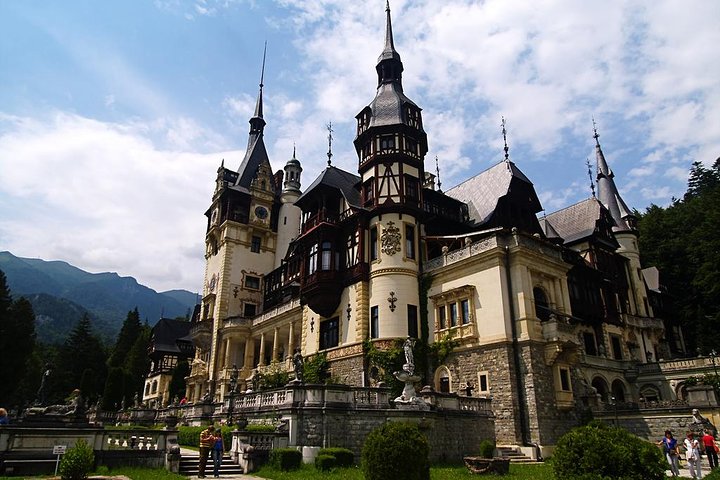
Peles Castle - Peles Castle, the summer residence of Romania’s royal family, was built in the 19th century by Carol the First. It is considered the most beautiful castle in Romania and possibly Europe. The castle is predominantly built in a German Renaissance manner, featuring 160 rooms and 30 bathrooms. The castle’s main characteristic is its intricate woodwork crafted by Bernhard Ludwig from Vienna.
Snagov Monastery - Situated on a small island outside Bucharest, Snagov Church is regarded as one of Southern Romania’s most important religious monuments. Originally part of a monastery, the church has held this status since medieval times when local princes endowed, fortified, and expanded it to support the Orthodox Church.
Closely linked to the era of Vlad the Impaler, who inspired the Dracula myth, Snagov Church was supposedly built on an ancient Dacian site. However, the religious monument was first mentioned in the second half of the 14th century when a local prince donated an entire village to the monastery.
This practice was common at the time, with more documents indicating further donations in the next century from medieval princes like Mircea the Old and Vlad Dracul.
The monastery’s church underwent numerous changes over the centuries and is one of the few remaining parts of the monastery today. The original frescoes by Dobromir the Young in 1563 are preserved only in the narthex, with the rest of the paintings dating from the 19th century.
The medieval frescoes’ importance, beyond their artistic value and detail, is enhanced by the large gallery of local princes painted on the church walls, making this ensemble one of the most beautiful in Southern Romania.
Besides the church, only the belfry, fountain, and some ruins remain from the once-powerful Monastery of Snagov. Built in a Byzantine style with local influences, the church features four towers, two above the altar, one above the nave, and one above the narthex. The church’s exterior retains its original brick decorations, while some authentic decorative religious objects are displayed at the National Art Museum in Bucharest.
Snagov Church is also part of the many legends surrounding Vlad the Impaler. Although never proven, this famous medieval prince was supposedly buried here by monks who found his body and kept the secret, fearing Ottoman retribution. A symbolic tomb of the prince is located inside the church, in front of the altar.
True or not, the church remains one of the most beautiful places near Bucharest, with its frescoes and scenic location on Snagov Lake making it an ideal destination for a trip outside the capital.

- Private tour
- ‘Skip the line’ access at Bran Castle and Peles Castle ticket offices
- Dinner included
- Professional English-speaking guide
- Breakfast included
- Free Wi-Fi in private car
- 5 nights’ accommodation in 3-star hotels
- Transport in a luxury Mercedes V-Class van or similar
- Private tour
- ‘Skip the line’ access at Bran Castle and Peles Castle ticket offices
- Dinner included
- Professional English-speaking guide
- Breakfast included
- Free Wi-Fi in private car
- 5 nights’ accommodation in 3-star hotels
- Transport in a luxury Mercedes V-Class van or similar
- Entraces fees
- Lunch and other meals
- Entraces fees
- Lunch and other meals
Explore the most significant and renowned regions of Romania – Transylvania and Bucovina.
Discover Unique Paintings and Centuries of History by visiting five of the most stunning and iconic painted churches in Bucovina. These monasteries are nestled in areas of exceptional beauty, surrounded by serene hills. The nearby villages are traditional Romanian…
Explore the most significant and renowned regions of Romania – Transylvania and Bucovina.
Discover Unique Paintings and Centuries of History by visiting five of the most stunning and iconic painted churches in Bucovina. These monasteries are nestled in areas of exceptional beauty, surrounded by serene hills. The nearby villages are traditional Romanian communities, featuring charming old houses and welcoming, hospitable residents.
Accommodations will be in a rustic country house, complete with a delightful dinner and a hearty breakfast.
This is a fantastic tour that blends the architecture of castles with that of medieval citadels.
Additionally, explore old Saxon villages with magnificent Saxon fortified churches.
Guests will be picked up from their hotel in Bucharest by a professional guide and will travel to Transylvania in a luxurious Mercedes V-Class van, ensuring the utmost comfort.
We are committed to making your holiday truly unforgettable.
- The mercedeThe an is luxury van with comfortable seats and full options, bizonal air conditioning (front and rear)
For a full refund, cancel at least 24 hours before the scheduled departure time.
For a full refund, cancel at least 24 hours before the scheduled departure time.