

Experience the best of Kyoto, Osaka, or Nara on a customizable day tour by car with an English guide. Choose your preferred location and explore top attractions like Osaka Castle, Arashiyama, and Nara Deer Park.
Experience the best of Kyoto, Osaka, or Nara on a customizable day tour by car with an English guide. Choose your preferred location and explore top attractions like Osaka Castle, Arashiyama, and Nara Deer Park.
-
Arashiyama - Arashiyama ranks as the second most significant sightseeing area in Kyoto. It boasts numerous temples and shrines, with the renowned Arashiyama Bamboo Grove as its highlight.
Arashiyama Bamboo Grove
The Arashiyama Bamboo Grove is a must-see in Kyoto, offering an otherworldly experience among its towering bamboo stalks.
Tenryu-ji Temple…
- Arashiyama - Arashiyama ranks as the second most significant sightseeing area in Kyoto. It boasts numerous temples and shrines, with the renowned Arashiyama Bamboo Grove as its highlight.
Arashiyama Bamboo Grove
The Arashiyama Bamboo Grove is a must-see in Kyoto, offering an otherworldly experience among its towering bamboo stalks.
Tenryu-ji Temple
Tenryu-ji Temple stands out in Arashiyama, featuring a vast Zen temple with one of Kyoto’s most exquisite gardens and stunning mountain vistas.
Kameyama-koen Park
Kameyama-koen Park provides a peaceful retreat from the crowds, where visitors might encounter monkeys in this charming hilltop park.
Okochi-Sanso Villa
Okochi-Sanso Villa is a top attraction in Kyoto, comparable to the city’s imperial properties, and no reservations are needed for entry.
- Kiyomizu-dera Temple - Kiyomizu-dera Temple
Kiyomizudera (清水寺, meaning “Pure Water Temple”) is one of Japan’s most esteemed temples. Established in 780 at the Otowa Waterfall site in Kyoto’s eastern wooded hills, it derives its name from the waterfall’s pure waters. Initially linked to the Hosso sect, one of Japan’s oldest Buddhist schools, it formed its own Kita Hosso sect in 1965. In 1994, it was designated a UNESCO World Heritage site.
Kiyomizudera is renowned for its wooden stage extending 13 meters above the hillside from its main hall. This stage offers splendid views of the cherry and maple trees below, which burst into vibrant colors in spring and fall, as well as the distant cityscape of Kyoto. The main hall, constructed without nails, houses the temple’s primary object of worship, a small statue of the eleven-faced, thousand-armed Kannon.
-
Kinkakuji Temple - Kinkakuji Temple
Kinkaku-ji, officially known as Rokuon-ji, is a Zen Buddhist temple in Kyoto, Japan. It is one of Kyoto’s most iconic buildings, drawing numerous visitors each year. -
Fushimi Inari-taisha Shrine - Fushimi Inari-taisha Shrine
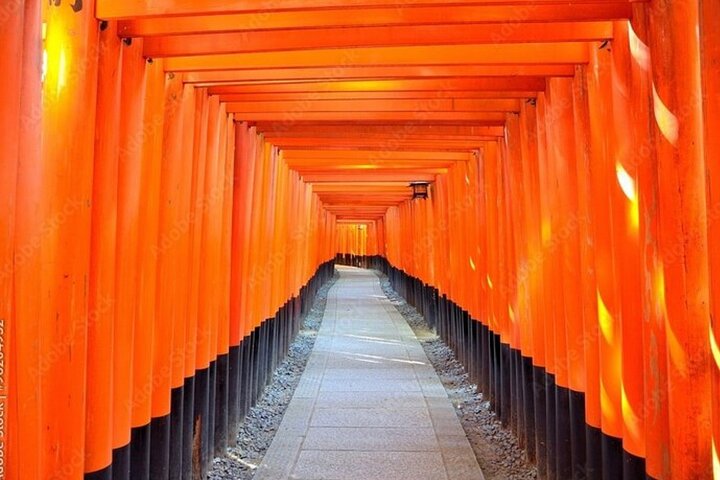
Fushimi Inari Shrine (伏見稲荷大社, Fushimi Inari Taisha) is a significant Shinto shrine in southern Kyoto. It is renowned for its thousands of vermilion torii gates, which line a network of trails behind its main buildings. These trails lead into the sacred Mount Inari’s wooded forest, standing at 233 meters and part of the shrine grounds.
Fushimi Inari is the most important among thousands of shrines dedicated to Inari, the Shinto deity of rice. Foxes are considered Inari’s messengers, resulting in numerous fox statues throughout the shrine grounds. Fushimi Inari Shrine has ancient origins, predating the capital’s relocation to Kyoto in 794.
- Gion - Gion
Gion (祇園) is Kyoto’s most renowned geisha district, situated around Shijo Avenue between Yasaka Shrine in the east and the Kamo River in the west. It is filled with shops, restaurants, and ochaya (teahouses), where geiko (Kyoto dialect for geisha) and maiko (geiko apprentices) entertain.
Gion attracts tourists with its high concentration of traditional wooden machiya merchant houses. Due to property taxes historically being based on street frontage, these houses were constructed with narrow facades only five to six meters wide, but extend up to twenty meters from the street.
- Sanjusangendo Temple - Sanjusangendo Temple
Sanjusangendo (三十三間堂, Sanjūsangendō) is the popular name for Rengeo-in, a temple in eastern Kyoto famous for its 1001 statues of Kannon, the goddess of mercy. The temple was founded in 1164 and rebuilt a century later after the original structure was destroyed by fire.
Measuring 120 meters, the temple hall is Japan’s longest wooden structure. The name Sanjusangendo (literally “33 intervals”) refers to the number of intervals between the building’s support columns, a traditional method of measuring a building’s size. In the center of the main hall sits a large wooden statue of a 1000-armed Kannon (Senju Kannon), flanked on each side by 500 human-sized 1000-armed Kannon statues standing in ten rows. Together, they create an awe-inspiring sight.
1000-armed Kannon are equipped with 11 heads to better witness human suffering and with 1000 arms to better assist in alleviating it.
- Ginkakuji Temple - Ginkakuji (銀閣寺, Silver Pavilion) is a Zen temple along Kyoto’s eastern mountains (Higashiyama). In 1482, shogun Ashikaga Yoshimasa constructed his retirement villa on the grounds of today’s temple, modeled after Kinkakuji (Golden Pavilion), his grandfather’s retirement villa at the base of Kyoto’s northern mountains (Kitayama). The villa was converted into a Zen temple after Yoshimasa’s death in 1490.
- Nishiki Market Shopping District - Nishiki Market Shopping District
Nishiki Market (“錦市場” in Japanese) is one of Kyoto’s most famous and bustling markets. Originally established as a fish market during the Edo period (1603 – 1868), this vibrant market has been a popular shopping district among locals for centuries. It is about a 5-minute subway ride and a 10-minute walk from JR Kyoto station.
This shopping area stretches approximately 390 meters along Nishiki-koji Street, a stone-paved narrow street that traverses central Kyoto from east to west. Stalls and shops at Nishiki Market offer an endless variety of food options, including Kyoto’s traditional specialties and reasonably priced delicious sweets.
-
Kyoto Imperial Palace - Kyoto Imperial Palace
The Kyoto Imperial Palace (京都御所, Kyōto Gosho) was the residence of Japan’s Imperial Family until 1868, when the emperor and capital moved from Kyoto to Tokyo. It is located in the expansive Kyoto Imperial Park (京都御苑, Kyōto Gyoen), an attractive park in the city’s center that also includes the Sento Imperial Palace, which served retired emperors, and several other attractions. - Nijo Castle - Nijo Castle
Nijo Castle (二条城, Nijōjō) was constructed in 1603 as the Kyoto residence of Tokugawa Ieyasu, the first shogun of the Edo Period (1603-1867). His grandson Iemitsu completed the castle’s palace buildings 23 years later and further expanded the castle by adding a five-story castle keep.
After the Tokugawa Shogunate fell in 1867, Nijo Castle served as an imperial palace for a time before being donated to the city and opened to the public as a historic site. Its palace buildings are considered the best surviving examples of castle palace architecture from Japan’s feudal era, and the castle was designated a UNESCO World Heritage site in 1994.
- Eikando Zenrinji Temple - Eikando Zenrinji Temple
Eikan-do Temple is the main temple of the Jodo-shu Seizan-Zenrinji school. It began as a training temple of Esoteric Buddhism of the Shingon sect in 853. Eikan, the 7th abbot, later converted the temple to the Jodo sect. Among the many temple treasures, the most intriguing is perhaps the Mikaeri Amida Nyorai, Amida Buddha looking back over his shoulder.
-
Yasaka Shrine - Yasaka Shrine
There are several theories about the origin of Yasaka Jinja Shrine. According to the shrine’s records, its history may date back to 656 (Heian Era), the second year of Emperor Saimei’s reign. Irishi, a messenger from Korea, brought the spirit of Susanoo-no-mikoto to this location.
Besides this view, in the Jogan Era, 876, a Buddhist priest from Nara Prefecture, Ennyo, built a temple and enshrined Susanoo-no-mikoto, the region’s deity.

- Private transportation
- Pick up & Drop off included
- Driver in person Tour Guide cost included
- In-vehicle air conditioning
- Price Including Highway Toll Tax+ Gasoline
- English Speaking Driver/Guide
- Meet & Greet
- Private transportation
- Pick up & Drop off included
- Driver in person Tour Guide cost included
- In-vehicle air conditioning
- Price Including Highway Toll Tax+ Gasoline
- English Speaking Driver/Guide
- Meet & Greet
- Entrance Fees • Accommodation Fees • Meals (Breakfast, Lunch, Dinner…)
- Entrance fees of any place or ride of any thing not included customer choice can skip or want to ho
- Admission fee for Kinkaku-ji Temple 500 yen (Adults), 300 yen (Students-grade 1-9
- Admission fee for Kiyomizu-dera - Adults: ¥400, Students: ¥200
- Osaka castle entrance fees…
- Entrance Fees • Accommodation Fees • Meals (Breakfast, Lunch, Dinner…)
- Entrance fees of any place or ride of any thing not included customer choice can skip or want to ho
- Admission fee for Kinkaku-ji Temple 500 yen (Adults), 300 yen (Students-grade 1-9
- Admission fee for Kiyomizu-dera - Adults: ¥400, Students: ¥200
- Osaka castle entrance fees
-
- Overtime charge 5000¥ per extra hour after 10 hours Hotel to Hotel Time
NOTE: Please select one location for your tour: KYOTO, OSAKA, or NARA. If you wish to visit all three, consider booking a 3-day tour to explore Kyoto, Osaka, and Nara.
We offer pick-up services for all travelers from their respective locations in OSAKA, Kyoto, KOBE, NARA, or from Osaka Kansai Airport or Osaka Cruise Terminal.
Alternatively, book with us,…
NOTE: Please select one location for your tour: KYOTO, OSAKA, or NARA. If you wish to visit all three, consider booking a 3-day tour to explore Kyoto, Osaka, and Nara.
We offer pick-up services for all travelers from their respective locations in OSAKA, Kyoto, KOBE, NARA, or from Osaka Kansai Airport or Osaka Cruise Terminal.
Alternatively, book with us, and we will reach out to discuss your preferred destination and arrange your pick-up and drop-off locations.
Our tours are fully customizable, allowing you to add or skip any destinations.
Osaka Itinerary:
- Osaka Castle
- Shitennoji Temple
- Shinsekai
- Sumiyoshi Taisha Shrine
- Sakai City Hall Observatory Floor
- Daisen Park
Kyoto Itinerary:
- Arashiyama
- Kinkakuji Temple
- Kiyomizu-dera Temple
- Fushimi Inari-taisha Shrine
- Gion
- Sanjusangendo Temple
- Ginkakuji Temple
- Nishiki Market Shopping District
Nara Itinerary:
- Nara Deer Park
- Todai-ji Temple
- Todai-ji Nigatsudo Kuden
- Wakakusayama Hill
- Horyu-ji Temple
- Kasuga Taisha Shrine
- Shinyakushiji Temple
- Naramachi Street
For a full refund, cancel at least 24 hours before the scheduled departure time.
For a full refund, cancel at least 24 hours before the scheduled departure time.