






Immerse yourself in the remarkable ancient ruins of Luxor on this full-day private tour. Explore the East and West Banks of the Nile, including the Valley of the Kings, Colossi of Memnon, and Karnak Temples.
Immerse yourself in the remarkable ancient ruins of Luxor on this full-day private tour. Explore the East and West Banks of the Nile, including the Valley of the Kings, Colossi of Memnon, and Karnak Temples.
-
Valley of the Kings - The Valley of the Kings is a famous archaeological site situated on the west bank of the Nile River in Egypt, across from present-day Luxor. It served as the burial site for pharaohs and influential nobles during the New Kingdom era of ancient Egypt, roughly between the 16th and 11th centuries BCE.
When exploring the Valley of…
- Valley of the Kings - The Valley of the Kings is a famous archaeological site situated on the west bank of the Nile River in Egypt, across from present-day Luxor. It served as the burial site for pharaohs and influential nobles during the New Kingdom era of ancient Egypt, roughly between the 16th and 11th centuries BCE.
When exploring the Valley of the Kings, there are several significant features and attractions to discover:
-
Tombs: The valley contains numerous rock-cut tombs where pharaohs and nobles were interred. Although the exact number of tombs is subject to ongoing archaeological findings, approximately 63 tombs have been uncovered so far. Noteworthy examples include the tombs of Tutankhamun, Ramses II, and Seti I.
-
Tutankhamun’s Tomb: Among the most renowned tombs in the Valley of the Kings is that of Tutankhamun, also known as King Tut. It was discovered by Howard Carter in 1922.
-
Temple of Hatshepsut at Deir el Bahari - Begin the Luxor City Tour by transferring to the west bank, where you will visit the Valley of the Kings, showcasing the magnificence of the architectural grandeur used for burials. Many kings are interred in this valley, with the most famous tombs being those of King Tutmosis I, Tutmosis III, Tut-Ankh-Amon, King Ramssess VI, King Mrenptah, and Amonhotep II. Proceed to visit the Temple of Queen Hatshepsut, constructed by Queen Hatshepsut, daughter of Thutmosis I, who ruled Egypt for about 20 years during the 18th Dynasty (approximately 1490-1469 B.C), the only female pharaoh to reign over ancient Egypt. You will pass by the Colossi of Memnon, which are remnants of the mortuary temple of Amenhotep III. Continue driving to the east bank of Luxor to enjoy lunch at a local restaurant before visiting the Karnak Temples, the greatest example of worship in history, dedicated to the God Amon, his wife Mut, and their son Khonsu. Conclude your tour by visiting the Temple of Luxor.
-
Colossi of Memnon - The two statues depict Amenhotep III seated on a throne. They stand about 60 feet (18 meters) tall and weigh an estimated 720 tons each.
-
The statues originally stood at the entrance to Amenhotep III’s memorial temple, which was one of the largest and most magnificent temples in ancient Thebes. Unfortunately, the temple itself has been largely destroyed over the centuries.
-
In 27 BC, one of the statues was damaged by an earthquake, causing it to produce a musical sound at sunrise, which was believed to be the “cry of Memnon” - Memnon being an Ethiopian king in Greek mythology. This phenomenon attracted many ancient tourists to witness it.
-
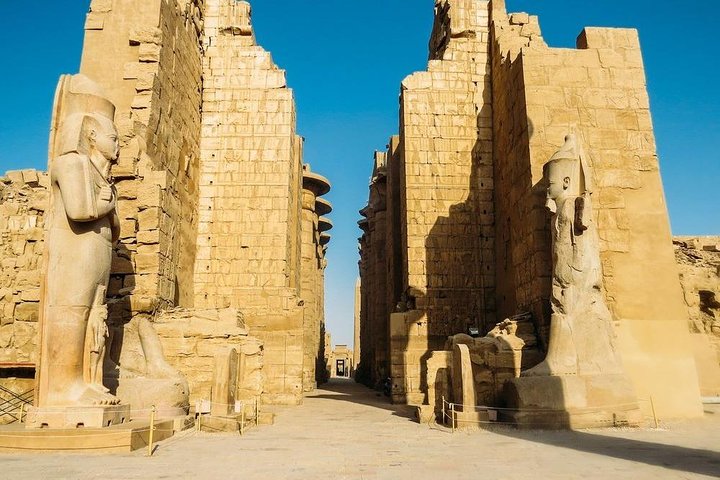
Temple of Karnak - The Karnak Temple Complex is an ancient Egyptian temple located near the modern city of Luxor, on the east bank of the Nile River in Egypt. It is one of the largest and most impressive temple complexes in Egypt and was dedicated primarily to the worship of the god Amun-Ra, although it also includes other smaller temples and sanctuaries dedicated to various deities.
The construction of the Karnak Temple Complex began in the Middle Kingdom, around 2000 BCE, and continued over a period of approximately 1,500 years, with successive pharaohs adding their own contributions. As a result, the complex represents the combined efforts of many generations of pharaohs and reflects different architectural styles and religious beliefs.
The centerpiece of the Karnak Temple is the Great Hypostyle Hall.
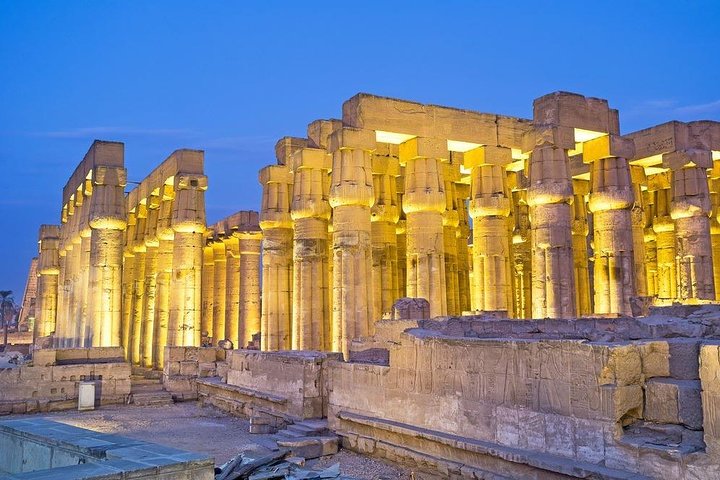
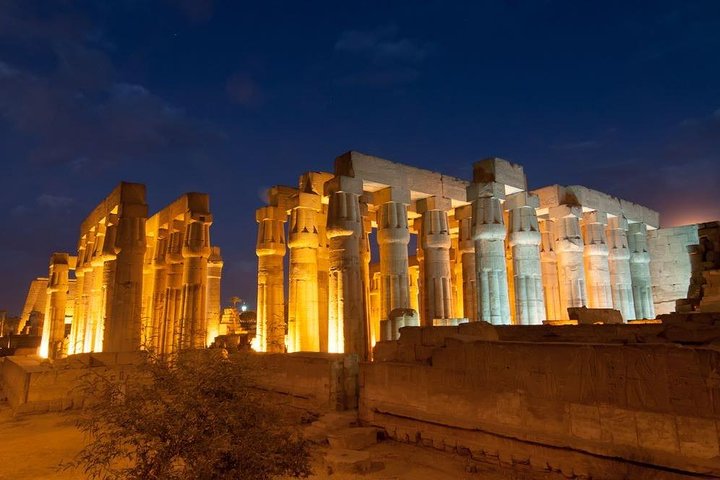
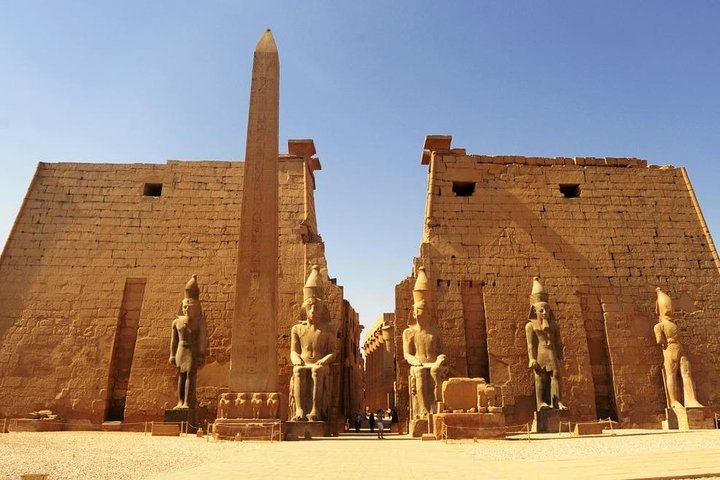
- Luxor Temple - Luxor Temple, also known as the Temple of Luxor, is another ancient Egyptian temple located in the city of Luxor, on the east bank of the Nile River. It is situated right in the heart of the modern city, making it easily accessible to visitors.
Luxor Temple was built primarily during the New Kingdom period of ancient Egypt, around the 14th century BCE, although later pharaohs also made additions to the temple. It was dedicated to the Theban Triad, consisting of the gods Amun, Mut, and their son Khonsu.
The temple complex is renowned for its impressive architecture and grandeur. It features a large colonnade and massive pylon gateways.
- Entrance fees to all the mentioned sites
- Lunch at a good quality restaurant
- Private English-speaking Egyptologist guide
- Pick up services from your hotel in Luxor and return
- All transfers by a private air-conditioned vehicle
- Bottled water on board the vehicle during the tour
- Entrance fees to all the mentioned sites
- Lunch at a good quality restaurant
- Private English-speaking Egyptologist guide
- Pick up services from your hotel in Luxor and return
- All transfers by a private air-conditioned vehicle
- Bottled water on board the vehicle during the tour
- Tipping
- Tipping
Luxor, a notable treasure chest of Egyptian antiquity, often presents restricted exploration possibilities in group tours. With a private, comprehensive day tour like this, you get an intimate exploration of the East and West Banks of the Nile. Top highlights include the UNESCO World Heritage Site, the Valley of the Kings, the iconic Colossi of Memnon,…
Luxor, a notable treasure chest of Egyptian antiquity, often presents restricted exploration possibilities in group tours. With a private, comprehensive day tour like this, you get an intimate exploration of the East and West Banks of the Nile. Top highlights include the UNESCO World Heritage Site, the Valley of the Kings, the iconic Colossi of Memnon, the Hatshepsut’s temple, the grand Karnak Temples, and the illustrious Luxor Temple.
For a full refund, cancel at least 24 hours before the scheduled departure time.
For a full refund, cancel at least 24 hours before the scheduled departure time.


