Explore Delhi’s rich history on a private full-day tour. Discover ancient empires, iconic landmarks, and vibrant culture with an expert guide.
Explore Delhi’s rich history on a private full-day tour. Discover ancient empires, iconic landmarks, and vibrant culture with an expert guide.
- India Gate - India Gate is a war memorial situated along the Rajpath, on the eastern side of New Delhi’s “ceremonial axis,” previously known as Kingsway.
- Rashtrapati Bhavan - Rashtrapati Bhavan serves as the official residence of the President of India, located at the western end. When Dr. Rajendra Prasad became the first President of India…
- India Gate - India Gate is a war memorial situated along the Rajpath, on the eastern side of New Delhi’s “ceremonial axis,” previously known as Kingsway.
- Rashtrapati Bhavan - Rashtrapati Bhavan serves as the official residence of the President of India, located at the western end. When Dr. Rajendra Prasad became the first President of India and took residence, it was renamed Rashtrapati Bhavan – the President’s House.
- Humayun’s Tomb - Humayun’s Tomb is the resting place of Mughal Emperor Humayun in Delhi, India. Commissioned by his first wife and chief consort, Empress Bega Begum, in 1569-70, it was designed by Mirak Mirza.
- Lotus Temple - The Lotus Temple, situated in Delhi, India, is a Bahá’í House of Worship dedicated in December 1986, with a construction cost of $10 million.
- Qutub Minar - The Qutub Minar, also known as Qutab Minar or Qutb Minar, is the tallest brick minaret in the world. It is part of the Qutab complex, a UNESCO World Heritage Site located in the Mehrauli area of Delhi, India.
- Birla Mandir Temple (Lakshmi Narayan) - Laxmi Narayan Temple, commonly referred to as Birla Mandir, is a prominent temple and tourist attraction in Delhi. It was constructed by the industrialist Sh. J.K. Birla in 1939.

- Bottled water
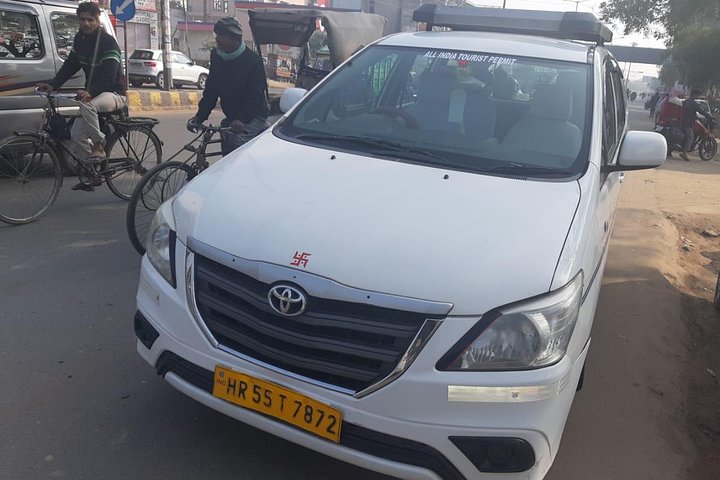
- Transport by private vehicle
- Bottled water
- Transport by private vehicle
- Alcoholic drinks (available to purchase)
- Food and drinks, unless specified
- Entrance fees
- Lunch
- Driver Tip
- Alcoholic drinks (available to purchase)
- Food and drinks, unless specified
- Entrance fees
- Lunch
- Driver Tip
Delhi has experienced political upheaval for more than five centuries. It was governed by the Mughals following the Khiljis and Tughlaqs.
In 1192, the forces of Afghan warrior Muhammad of Ghori seized the Rajput town, leading to the establishment of the Delhi Sultanate in 1206. Timur’s invasion of Delhi in 1398 marked the end of the sultanate; the Lodis,…
Delhi has experienced political upheaval for more than five centuries. It was governed by the Mughals following the Khiljis and Tughlaqs.
In 1192, the forces of Afghan warrior Muhammad of Ghori seized the Rajput town, leading to the establishment of the Delhi Sultanate in 1206. Timur’s invasion of Delhi in 1398 marked the end of the sultanate; the Lodis, the last of the Delhi sultans, were succeeded by Babur, who founded the Mughal Empire after the Battle of Panipat in 1526. Initially, the early Mughal emperors preferred Agra as their capital, but Delhi became their permanent seat when Shah Jahan constructed the walls of Old Delhi in 1638.
For a full refund, cancel at least 24 hours before the scheduled departure time.
For a full refund, cancel at least 24 hours before the scheduled departure time.