




Embark on a full day private tour of Phnom Penh and explore the Royal Palace, Toul Sleng Genocide Museum, and more. Discover Cambodia’s past with an insightful guide and capture stunning photos of famous destinations.
Embark on a full day private tour of Phnom Penh and explore the Royal Palace, Toul Sleng Genocide Museum, and more. Discover Cambodia’s past with an insightful guide and capture stunning photos of famous destinations.
- Phnom Penh - Phnom Penh, the bustling capital of Cambodia, is located at the confluence of the Mekong and Tonlé Sap rivers. It served as a significant center for both the Khmer Empire and French colonialists. The city boasts a walkable riverfront adorned with parks, restaurants, and bars, featuring the ornate Royal Palace, Silver Pagoda, and the…
- Phnom Penh - Phnom Penh, the bustling capital of Cambodia, is located at the confluence of the Mekong and Tonlé Sap rivers. It served as a significant center for both the Khmer Empire and French colonialists. The city boasts a walkable riverfront adorned with parks, restaurants, and bars, featuring the ornate Royal Palace, Silver Pagoda, and the National Museum, which showcases artifacts from across the nation. At the city’s core lies the expansive, art deco Central Market.
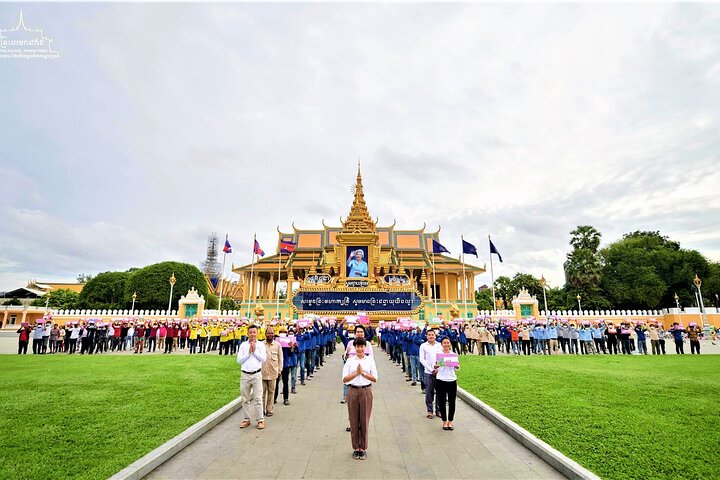
- Royal Palace - The Royal Palace stands as one of Phnom Penh’s most iconic landmarks. Construction began in 1886 after King Norodom moved the royal capital to Phnom Penh, and it was completed before World War I. To this day, the palace remains the primary residence of the King of Cambodia.
- Silver Pagoda - The stunning Silver Pagoda is situated next to the Royal Palace in Phnom Penh. Its beautiful garden offers a serene escape from the bustling streets of Cambodia’s capital. Inside, the pagoda is equally impressive, with countless handcrafted silver tiles covering the floor. It is also known as the Temple of the Emerald Buddha, as the main Buddha statue is crafted from emerald or baccarat crystal.
- Tuol Sleng Genocide Museum - The Tuol Sleng Genocide Museum in Phnom Penh, Cambodia’s capital, documents the Cambodian genocide. The site was formerly a secondary school used as Security Prison 21 (S-21) by the Khmer Rouge regime from 1975 to 1979. An estimated 20,000 people were imprisoned at Tuol Sleng during this period, though the exact number is unknown. Tuol Sleng translates to “Hill of the Poisonous Trees” or “Strychnine Hill.” It was one of at least 150 torture and execution centers established by the Khmer Rouge, with some sources citing up to 196 prison centers. On July 26, 2010, the Extraordinary Chambers in the Courts of Cambodia convicted the chief of Tuol Sleng Prison, Kang Kek Iew (alias Duch), for crimes against humanity and grave breaches of the 1949 Geneva Conventions, sentencing him to life imprisonment.
- Choeung Ek Genocidal Center - Choeung Ek, located about 17 kilometers south of Phnom Penh, Cambodia, was once an orchard and mass grave for victims of the Khmer Rouge between 1975 and 1979. It is the most well-known of the sites referred to as The Killing Fields, where the Khmer Rouge regime executed over one million people. After the fall of the regime, mass graves containing 8,895 bodies were discovered at Choeung Ek. Many of the deceased were former political prisoners held by the Khmer Rouge at Tuol Sleng and other detention centers. Today, Choeung Ek serves as a memorial, marked by a Buddhist stupa with acrylic glass sides filled with over 5,000 human skulls. Some lower levels are open during the day for direct viewing of the skulls, many of which are shattered or smashed.
- Wat Phnom - Wat Phnom, perched atop a tree-covered knoll 27 meters high, is the only hill in town. According to legend, the first pagoda on this site was built in 1373 to house four Buddha statues deposited by the Mekong’s waters and discovered by a woman named Penh. The main entrance to Wat Phnom is via the grand eastern staircase, guarded by lions and naga (snake) balustrades.
- Statue of King Father Norodom Sihanouk - The Statue of King Father Norodom Sihanouk is a prominent bronze memorial located in the Independent Square at the center of Phnom Penh.
- Independence Monument - The Independence Monument in Phnom Penh, Cambodia’s capital, was constructed in 1958 to commemorate Cambodia’s independence from France in 1953. It stands at the intersection of Norodom Boulevard and Sihanouk Boulevard in the city center. The monument is designed in the form of a lotus-shaped stupa, similar to those seen at the Khmer temple at Banteay Srei and other Khmer historical sites. Designed by Cambodian architect Vann Molyvann, it stands 37 meters tall. During national celebrations, the Independence Monument becomes the focal point of activities. A ceremonial flame on the interior pedestal is often lit by a royal or high official on these occasions, and floral tributes adorn the stairs. Each year, the Independence Monument attracts both foreign tourists and locals. Behind the monument is the Norodom Sihanouk Memorial, built in 2013.
- Wat Ounalom - Wat Ounalom is one of Phnom Penh’s five original monasteries, established in 1422. It housed the Institute Bouddhique and library. Located on the riverfront about 250 meters north of the Royal Palace, facing the Tonle Sap River, this pagoda serves as the headquarters for one of Cambodia’s most esteemed Buddhist patriarchs. Ounalom Pagoda is a major tourist attraction in Phnom Penh. With its numerous pagodas, parks, monuments, and museums, Phnom Penh is an ideal destination for vacationers. A visit to Ounalom Pagoda will enhance your trip to this city.
- Central Market - The Central Market, a large market built in 1937, features a dome with four arms extending into vast hallways filled with countless stalls. Initially designed by Jean Desbois (1891 Cherbourg -1971 Lorient), construction was overseen by French architect Louis Chauchon (1875 - 1945 Saigon) and the ingénue Wladimir Kandaouroff. Located in Cambodia’s capital, Phnom Penh, it was once considered the largest market in Asia when it opened in 1937 and continues to operate as a market today. From 2009 to 2011, it underwent a US$4.2 million renovation funded by the French Development Agency. The unique Art Deco building is a landmark in Phnom Penh. Before 1935, the area was a lake that collected runoff during the rainy season. The lake was drained, and construction began in 1935. Since its completion in 1937, wet season flooding around the market has persisted, serving as a vestigial reminder of the old lake.

- All admission entrance tickets included
- Hotel pick-up and drop-off in Phnom Penh
- Private air-conditioned vehicle transfers
- Complimentary cool drinking water
- Experienced English-speaking tour guide
- Service charges and government VAT tax included
- All admission entrance tickets included
- Hotel pick-up and drop-off in Phnom Penh
- Private air-conditioned vehicle transfers
- Complimentary cool drinking water
- Experienced English-speaking tour guide
- Service charges and government VAT tax included
- Tipping for tour guide and driver
- Lunch
- Tipping for tour guide and driver
- Lunch
Embark on an adventure through Phnom Penh with this full day private tour and best tours choice in Phnom Penh of the most popular attractions as Royal Palace, Silver Pagoda, Wat Phnom, Toul Sleng Genocide Museum, Wat Oudnaloum, Independence Monument, Cheung Ek Genocide Center at Killing Field and Central Market.
- Private tour from Phnom Penh with…
Embark on an adventure through Phnom Penh with this full day private tour and best tours choice in Phnom Penh of the most popular attractions as Royal Palace, Silver Pagoda, Wat Phnom, Toul Sleng Genocide Museum, Wat Oudnaloum, Independence Monument, Cheung Ek Genocide Center at Killing Field and Central Market.
- Private tour from Phnom Penh with professional English speaking tour guide
- Informative commentary of Cambodia’s past from an insightful personal guide
- Explore the magnificent Phnom Penh of all most popular attractions
- Travel by private comfortable air-con vehicle
For a full refund, cancel at least 24 hours before the scheduled departure time.
For a full refund, cancel at least 24 hours before the scheduled departure time.


