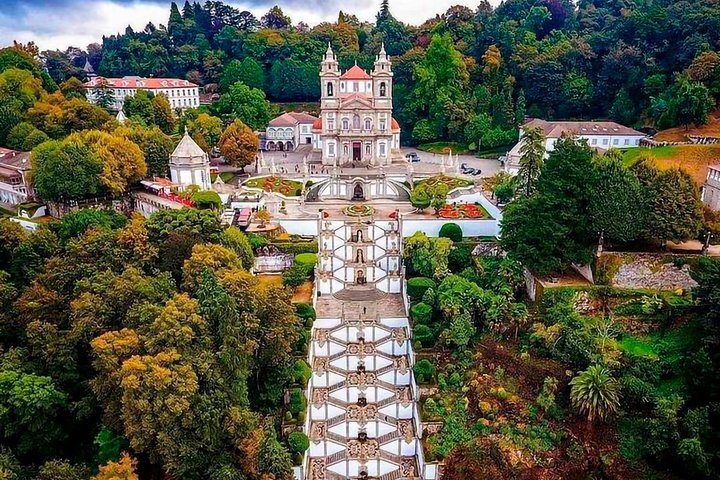
Discover the preserved medieval center of Guimarães, Portugal’s cradle city. Explore its history, monuments, suburbs, gastronomy, and nature on a full-day tour.
Discover the preserved medieval center of Guimarães, Portugal’s cradle city. Explore its history, monuments, suburbs, gastronomy, and nature on a full-day tour.
- Guimaraes Castle - The construction of the Palace of the Dukes of Bragança, inspired by typical French manor houses, began in the early 15th century. It was commissioned by D. Afonso de Barcelos, the first Duke of Bragança and the illegitimate son of D. João, Master of Avis, who later became King D. João I. As the Dukes of Bragança later relocated…
- Guimaraes Castle - The construction of the Palace of the Dukes of Bragança, inspired by typical French manor houses, began in the early 15th century. It was commissioned by D. Afonso de Barcelos, the first Duke of Bragança and the illegitimate son of D. João, Master of Avis, who later became King D. João I. As the Dukes of Bragança later relocated to the Palace of Vila Viçosa in Alentejo, the building gradually fell into disrepair over the centuries until it was converted into a military barracks in 1807.
In 1937, restoration work commenced, and on June 24, 1959, exactly 831 years after the Battle of São Mamede, the palace was revived in its Norman-inspired Gothic splendor.
- Igreja de Sao Miguel do Castelo - The Church of São Miguel do Castelo is closely linked to Guimarães Castle and the foundation of the Portuguese nation, as it is believed that Portugal’s first king, Afonso Henriques, was baptized here. The earliest known reference to the church dates back to 1216. In medieval times, it served as a venue for some town council hearings, making it a hub for administrative and social gatherings. In 1664, the prior D. Diogo Lobo da Silveira relocated the baptismal font from the Church of S. Miguel to the Church of Nossa Senhora da Oliveira.
Over the centuries, it has undergone several phases of ruin and restoration. In September 1927, it returned to its original location, for the same reason it had been moved - to highlight the baptismal font believed to have been used for King Afonso Henriques.
- Paco dos Duques de Braganca - Built by the eighth Count of Barcelos, later the first Duke of Bragança, Afonso, the illegitimate son of King João I, its construction took place between 1420 and 1433, likely beginning during Afonso’s second marriage to Constança de Noronha.
It is believed that during the 1500s, the palace was still used as the residence of the Dukes of Bragança, but it gradually fell into neglect and ruin. In the 19th century, during the French invasions, the palace was converted into military barracks. In the following century, during the Estado Novo regime, the Paço dos Duques was rebuilt between 1937 and 1959.
It was inaugurated on June 25, 1959. The pieces decorating the rooms open to the public are designed to create the illusion that visitors are entering an inhabited house. The tapestry, furniture, ceramics, painting, and armory collections are particularly noteworthy.
- Igreja Nossa Senhora do Carmo - The construction of the church and convent of Carmo began in 1685, showcasing the Baroque style. The convent was dedicated to Saint Teresa.
In the early 1700s, a papal bull authorized those gathered at Saint Teresa’s to take the veil of Discalced Carmelite nuns, already under the invocation of Saint Joseph. However, the main altar was occupied by the image of Our Lady of Mount Carmel, the most common and well-known invocation.
The body of the church is separated from the chancel by a stone arch and is enriched by two side altars: one dedicated to St. Anne and the other to Our Lady of Mount Carmel. In the old choir, there is another altar dedicated to the Dead Lord, erected by particular initiative and devotion.
With the official dissolution of the religious orders, the church and convent became state property and were used for military purposes. In 1862, the building became home to the current Lar de Santa Estefânia.
- Rua de Santa Maria - One of the first streets built in Guimarães, it was intended to connect the convent founded by Mumadona, surrounded by the lower part of the town, and the Castle located in the upper part of the town. It is already referred to by this name in documents dating back to the 12th century.
Along its route, various architectural testimonies of its past can be found: the Convent of Santa Clara, the Casa do Arco, the Casa dos Peixotos, and the Gothic Casa dos Valadares, among others, which give it its unique identity and characteristics in the city of Guimarães. It is also known as the preferred area of residence for the city’s dignitaries: the clergy, nobility, and affluent merchants.
- Antigo Convento de Santa Clara - One of the wealthiest convents in Guimarães, it was established in the 16th century by the Canon Master School of the Collegiate Church of Nossa Senhora da Oliveira, Baltasar de Andrade.
The building features a Baroque facade with a central sculpture of Santa Clara. The two-story cloister is of a classical type. Its richly adorned chapel was emptied in the 19th century, with some of the gilded carvings now housed in the Alberto Sampaio Museum. The Guimarães City Hall is now located in this building.
- Centro Historico de Guimaraes - The historic town of Guimarães is associated with the emergence of the Portuguese national identity in the 12th century. An exceptionally well-preserved and authentic example of the evolution of a medieval settlement into a modern town, its rich building typology exemplifies the specific development of Portuguese architecture from the 15th to 19th century through the consistent use of traditional building materials and techniques.
- Igreja de Nossa Senhora da Oliveira - The origins of the Insigne e Real Colegiada de Nossa Senhora da Oliveira date back to the monastery dedicated to the Savior of the World, the Virgin of Santa Maria, and the Holy Apostles, founded by Countess Mumadona Dias around 950. The invocation of Our Lady of the Olive Tree prevailed after 1342, with the sprouting of an olive tree in the front square. The current building is evidence of successive renovations and additions, incorporating elements from different periods - the Gothic reconstruction promoted by King João I; the Manueline church tower, completed around 1513-1515; the chancel, of classical architecture, rebuilt in the 17th century by King Pedro II; the church’s main chapel. The stuccoes in the main and side chapels are references to the neoclassical renovation begun in 1830; the last intervention dates back to the 20th century and aimed to leave the granite of the walls and the columns of medieval origin visible. Classified as a national monument since 1910.
- Largo da Oliveira - The Largo da Oliveira owes its name to a centuries-old olive tree planted on this site. Surrounded by picturesque houses typical of northern Portugal, it is the ideal starting point for a walking tour of the city’s streets. In the square itself, there are also several interesting features: on the eastern side is a curious Gothic shrine, built during the reign of D. Afonso IV to commemorate the Battle of Salado, where Portuguese and Castilian forces together defeated the Moorish army from Granada in 1340.
Behind this is the Igreja de Nossa Senhora de Oliveira (or the Igreja da Colegiada - the Collegiate Church of Our Lady of the Olive Tree), the first Gothic monument built in the Minho, under the auspices of D. João I, in fulfillment of a vow made in return for victory against the Castilian army in the Battle of Aljubarrota (1385).
- Montanha- Parque da Penha - At the top of Penha mountain, you will find the Sanctuary of Nossa Senhora da Penha, a renowned pilgrimage site. The chapel, built in 1652, served as the Convent of the Imaculada Conceição as early as 1727. While visiting the Sanctuary, be captivated by the stunning set of tiles and the beautiful pulpit.
While there, explore several caves and enjoy the magnificent views from the natural viewpoints. Penha mountain offers a wide range of activities: a mountain campsite, a mini-golf course, an outdoor exercise area, an equestrian center, a picnic area, pedestrian tracks, restaurants, bars, and coffee shops.

- Pickup & Drop-off
- Local guide
- Visit of several monuments (up to 5 monuments)
- Full day tour (9h)
- Insurance, Taxes and fees
- Pickup & Drop-off
- Local guide
- Visit of several monuments (up to 5 monuments)
- Full day tour (9h)
- Insurance, Taxes and fees
- Other expenses and activities not mentioned
- Tips/Gratuities (optional)
- Any kind of worries
- Lunch
- Other expenses and activities not mentioned
- Tips/Gratuities (optional)
- Any kind of worries
- Lunch
Guimarães boasts one of Portugal’s most well-preserved medieval centers, where time appears to have stood still in a magical way.
Discover more than just the history and monuments of Guimarães. Explore the city’s outskirts, rich in traditions, historical and cultural heritage, local cuisine, and natural beauty.
Its Historic Center, a UNESCO World…
Guimarães boasts one of Portugal’s most well-preserved medieval centers, where time appears to have stood still in a magical way.
Discover more than just the history and monuments of Guimarães. Explore the city’s outskirts, rich in traditions, historical and cultural heritage, local cuisine, and natural beauty.
Its Historic Center, a UNESCO World Heritage Site, is a city of medieval origin dating back to the tenth century. Known as the “Cradle of the Nation” or “Cradle City” for its pivotal role in the formation of Portugal, it is also the birthplace of the first Portuguese King.
Highlights:
• Full-day tour (9 hours)
• Pickup & Drop-off
• Entrance to monuments
• UNESCO Heritage site
• Tour photos
• Small groups (maximum 6 people)
- Child rate applies only when sharing with 2 paying adults
For a full refund, cancel at least 24 hours before the scheduled departure time.
For a full refund, cancel at least 24 hours before the scheduled departure time.