
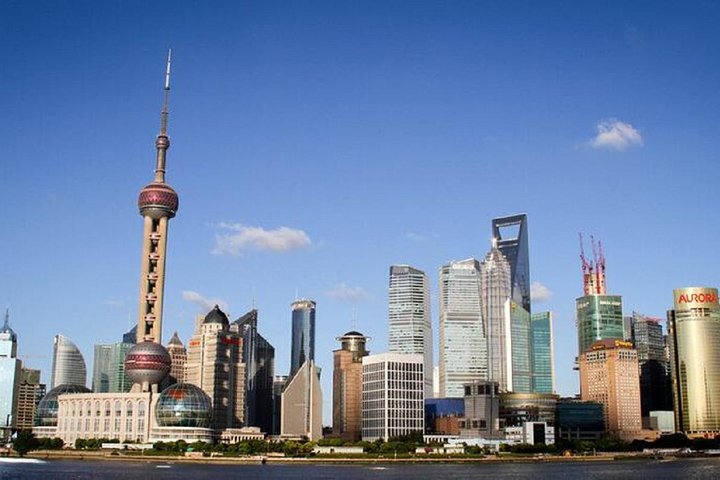


Often called the Eastern Paris, Shanghai epitomizes the blending of Eastern and Western cultures. Whether you’re strolling through the classic Chinese Yuyuan Garden & Bazaar, or marveling at the international architectural showcase on the Bund, you’ll experience a remarkable fusion of tradition and modernity, East and West.
Often called the Eastern Paris, Shanghai epitomizes the blending of Eastern and Western cultures. Whether you’re strolling through the classic Chinese Yuyuan Garden & Bazaar, or marveling at the international architectural showcase on the Bund, you’ll experience a remarkable fusion of tradition and modernity, East and West.
-
Shanghai Museum (Shanghai Bowuguan) - 08:30 AM: Meet the local tour guide in the hotel lobby to begin the city tour.
The first stop is the Shanghai Museum (closed on Mondays, replaced by the City Planning Centre).
Situated in the heart of Shanghai at People’s Square, the Shanghai Museum is a vast repository of ancient Chinese art. Its architectural…
- Shanghai Museum (Shanghai Bowuguan) - 08:30 AM: Meet the local tour guide in the hotel lobby to begin the city tour.
The first stop is the Shanghai Museum (closed on Mondays, replaced by the City Planning Centre).
Situated in the heart of Shanghai at People’s Square, the Shanghai Museum is a vast repository of ancient Chinese art. Its architectural design, featuring a round dome and square base, symbolizes the ancient concept of a round heaven and square earth. Visitors are surrounded by artifacts that reflect ancient wisdom and philosophy.
The museum is organized into eleven galleries and three exhibition halls. These galleries encompass major categories of Chinese art, including Ancient Bronze, Ancient Ceramics, Paintings, Calligraphy, Ancient Sculpture, Ancient Jade, Coins, Ming and Qing Furniture, Seals, and Minority Nationalities.
The ancient ceramics collection is a highlight of the Shanghai Museum. With over 500 pieces, it showcases artwork from various dynasties, such as painted and gray pottery from the Neolithic age, primitive celadon from the Shang, Zhou, and Warring States, mature celadon from the East Han Dynasty, the renowned tri-colored glazed pottery from the Tang Dynasty, and blue, white, and black glazed as well as painted porcelain from the Song, Jin, and Liao periods. The collection also includes exquisite works from Jingdezhen, Jiangxi, the industry center during the Yuan, Ming, and Qing dynasties.
- Jade Buddha Temple - Next, visit the Jade Buddha Temple.
Located in the northwest near the intersection of Anyuan Lu and Jiangning Lu, this active temple draws numerous visitors, both local and international. It is one of the few Buddhist temples in Shanghai.
Constructed between 1911 and 1918, the Jade Buddha Temple houses 70 resident monks. Its bright saffron walls make it easily recognizable. Inside, the centerpiece is a two-meter-high white jade sitting Buddha adorned with jewels, weighing approximately 1,000 kg. This statue was brought by monks from Burma to Zhejiang Province in 1882. A smaller reclining Buddha rests on a redwood bed.
- The Bund (Wai Tan) - In the afternoon, enjoy a leisurely walk along the Bund before heading to the stunning Southern Chinese garden, Yu Garden.
The Bund, also known as Zhongshan Road, is a renowned waterfront and has been a symbol of Shanghai for centuries. It stretches from the Baidu Bridge, where the Huangpu River meets the Suzhou Creek, to East Jinling Road, covering a length of 1,500 meters (less than one mile). Walking along the Bund on the west shore of the Huangpu River, visitors can see the Oriental Pearl TV Tower and the Jin Mao Tower on the opposite side. As one of the Top Ten Shanghai Attractions, the Bund is a beautiful and unique place worth visiting.
Yu Garden, Old Bazaar
Yuyuan Garden, a serene oasis in the bustling heart of Shanghai, dates back to the illustrious Ming Dynasty. Now a popular tourist spot, Yuyuan was originally a private garden created by Pan Yunduan, who spent nearly 20 years and all his savings to build it as a gesture of filial piety to please his parents in their old age. The name “Yuyuan” reflects this sentiment, as “yu” in Chinese means “peace and health.”

- Lunch at a local restaurant, including a soft drink
- Private vehicle transfer with a professional driver
- Admission to main attractions as per itinerary
- Guidance from an English-speaking tour guide
- Lunch at a local restaurant, including a soft drink
- Private vehicle transfer with a professional driver
- Admission to main attractions as per itinerary
- Guidance from an English-speaking tour guide
- Gratuities
- Gratuities
For a full refund, cancel at least 24 hours before the scheduled departure time.
For a full refund, cancel at least 24 hours before the scheduled departure time.


