

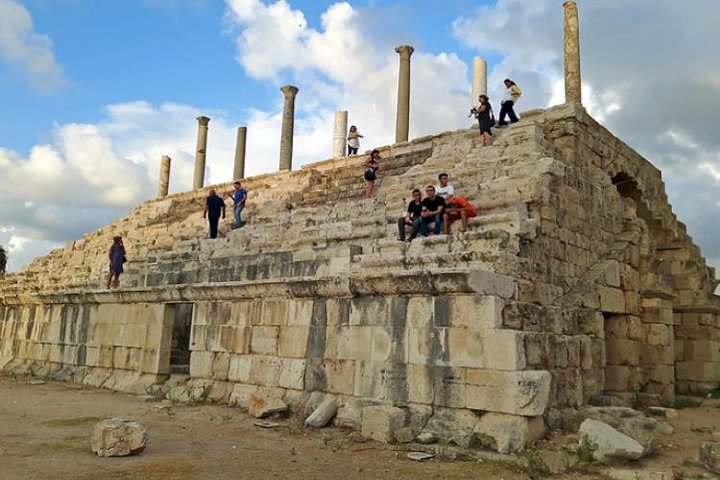

Embark on a private guided tour of historic Tyre and Sidon from Beirut. Immerse yourself in the rich history of Phoenicia as you explore ancient sites and learn fascinating stories about these important cities. Don’t miss the iconic tower of Our Lady of Mantara in Maghdouché. Book your tour now!
Embark on a private guided tour of historic Tyre and Sidon from Beirut. Immerse yourself in the rich history of Phoenicia as you explore ancient sites and learn fascinating stories about these important cities. Don’t miss the iconic tower of Our Lady of Mantara in Maghdouché. Book your tour now!
- Sidon - Sidon, one of the most ancient Phoenician cities, was established in the 3rd millennium BC and flourished in the 2nd millennium BC. Renowned for its purple dyes and glassware, Sidon was also visited by Jesus. Throughout the Crusades, Sidon frequently changed rulers and was both destroyed and rebuilt.
- Crusaders Sea Castle - Constructed…
- Sidon - Sidon, one of the most ancient Phoenician cities, was established in the 3rd millennium BC and flourished in the 2nd millennium BC. Renowned for its purple dyes and glassware, Sidon was also visited by Jesus. Throughout the Crusades, Sidon frequently changed rulers and was both destroyed and rebuilt.
- Crusaders Sea Castle - Constructed by the Crusaders in the 13th century, the Sidon Sea Castle is situated on a small island linked to the mainland by a causeway, serving as a fortress in the Holy Land. It stands as a significant historical landmark in Sidon, Lebanon. The Mamluks largely destroyed the castle in 1291, but it was later restored by Fakhr el-Dine Maan II in the early 17th century. Historical prints depict the fortress as a site of great beauty, though few of its original decorations remain.
- Khan al-Franj - Khan al-Franj is a key attraction in Sidon. Built in the early 17th century by Emir Fakhreddine II, it served as a hotel for ambassadors and a hub for commercial exchange between Lebanon and France. The hotel quickly became a center for literature, religion, history, industry, and diplomacy, embodying culture and civilization. It features a typical khan design with a large rectangular courtyard, a central fountain, and surrounding covered galleries.
- Sidon Souks - The souk of Sidon is the heart of retail and craft industry activities. It is a labyrinth of narrow alleyways filled with small kiosks, shops, cafes, street vendors, butchers, grocers, shoemakers, tailors, and jewelers.
- Basilica of Our Lady of Mantara - بازيليك سيدة المنطرة - Our Lady of Awaiting, also known as Our Lady of Mantara, is a Melkite Greek Catholic shrine located in Maghdouché, Lebanon. Discovered on 8 September 1721 by a young shepherd, the shrine includes a tower topped with a statue of the Virgin and Child, a cathedral, a cemetery, and a sacred cave believed to be where the Virgin Mary rested while waiting for Jesus.
- Tyre - Tyre is an ancient Phoenician port city and the birthplace of Elissar, the Phoenician princess who founded Carthage. It was globally renowned for its purple dye made from murex sea snails. Two main archaeological sites, “Al-Bass” and “Al-Mina,” highlight its historical importance. With a stunning seaside location, Tyre is a popular holiday destination known for its excellent and pristine beaches. The town’s origins date back to around 2750 BC, and it was subsequently ruled by the Egyptians and the notable King Hiram, under whom it thrived. It was later colonized by the Assyrians, Neo-Babylonians, Greeks, Seleucids, Romans, Byzantines, Arabs, Crusaders, Mamluks, and Ottomans.
- Al-Bass Archaeological Site - The Al Bass Archaeological Site is the largest and best-preserved example of a Roman Hippodrome. The Tyre El Bass sector, which served as the main entrance to the town in ancient times, includes the remains of a necropolis on either side of a wide monumental causeway dominated by a Roman triumphal arch from the 2nd century AD. Other remnants include an aqueduct and the 2nd-century hippodrome, one of the largest in the Roman world. The site contains a necropolis with several hundred well-preserved sarcophagi, an intact Roman road, an aqueduct, and a monumental arch.

- Tour Leader
- Hotel pickup and drop-off
- In-vehicle air conditioning
- Guided Tour of Tyre
- Comfortable Private Transportation
- Tour Leader
- Hotel pickup and drop-off
- In-vehicle air conditioning
- Guided Tour of Tyre
- Comfortable Private Transportation
- Lunch
- Gratuities
- Lunch
- Gratuities
Delve into history by visiting Tyre and Sidon, the two most significant cities of Phoenicia. Tyre, a prominent Phoenician city, dominated the seas and established thriving colonies. It is among the oldest continuously inhabited cities globally, boasting numerous ancient sites, including the Tyre Hippodrome. Sidon, another key Phoenician city, is…
Delve into history by visiting Tyre and Sidon, the two most significant cities of Phoenicia. Tyre, a prominent Phoenician city, dominated the seas and established thriving colonies. It is among the oldest continuously inhabited cities globally, boasting numerous ancient sites, including the Tyre Hippodrome. Sidon, another key Phoenician city, is possibly the oldest. Discover both cities in a single day, enjoying engaging commentary at each location without the need to drive or plan an itinerary. Conclude the journey at Maghdouché’s renowned landmark, the tower of Our Lady of Mantara, a Marian shrine believed to be where the Virgin Mary rested while waiting for Jesus as he preached in Sidon.
For a full refund, cancel at least 24 hours before the scheduled departure time.
For a full refund, cancel at least 24 hours before the scheduled departure time.


