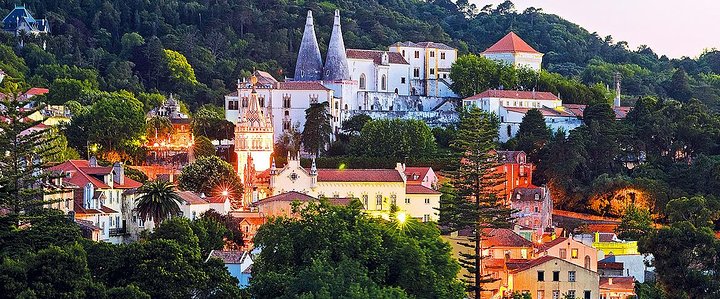
Experience the best of Lisbon and Sintra on a private 2-day tour. Explore these two cities with comfort and flexibility, with air-conditioned vehicles, Wi-Fi, and bottled water provided. Customize your itinerary and make the most of your time in each location. Book now!
Experience the best of Lisbon and Sintra on a private 2-day tour. Explore these two cities with comfort and flexibility, with air-conditioned vehicles, Wi-Fi, and bottled water provided. Customize your itinerary and make the most of your time in each location. Book now!
Sintra, Cabo da Roca, Guincho, and Cascais
Park and National Palace of Pena - The magnificent Palace of Pena is one of the finest examples of 19th-century romantic revivalism in Portugal.
Located on the Pena Hill, the Palace was built on the site of a former monastery of the Order of Saint Jerome. It was the brainchild of King Ferdinand II of…
Sintra, Cabo da Roca, Guincho, and Cascais
Park and National Palace of Pena - The magnificent Palace of Pena is one of the finest examples of 19th-century romantic revivalism in Portugal.
Located on the Pena Hill, the Palace was built on the site of a former monastery of the Order of Saint Jerome. It was the brainchild of King Ferdinand II of Saxe-Coburg and Gotha, who married Queen Maria II in 1836. Enchanted by Sintra, he decided to acquire the monastery and surrounding lands to construct the royal family’s summer palace.
The king consort adopted Portuguese architectural and decorative styles for the palace, in line with the revivalist taste (neo-Gothic, neo-Manueline, neo-Islamic, neo-Renaissance) and created a magnificent English-style park with a variety of exotic tree species.
Inside, still decorated in the style of the kings who lived there, the chapel stands out, featuring a magnificent alabaster marble altarpiece attributed to Nicolau Chanterenne (one of the architects of the Jerónimos Monastery in Lisbon). Also noteworthy are the trompe l’oeil murals and the tile coverings.
Sintra - Take time to stroll through the narrow streets of Sintra Village and enjoy its traditional conventual pastries.
Next, there are two options to visit:
1 - National Palace;
2 - Quinta da Regaleira
Sintra National Palace - The millennial history of the Sintra National Palace begins during the Muslim rule in the Iberian Peninsula. Already mentioned in the 11th century, the original Moorish palace - owned by the Portuguese Crown after the conquest of Lisbon by King Afonso Henriques (1147), the first King of Portugal - was first intervened in 1281, during the reign of King Dinis. New structures were added over time, under the reigns of King Dinis, King João I, and King Manuel I, maintaining its silhouette since the mid-16th century.
The arrangement of spaces in height, adapting to the terrain; the intimate organization of open-air inner courtyards, where the sound of running water can be heard; its windows with horseshoe arches; and the rich geometric patterned tile coverings, highlight the Moorish connection of the artisans who built and embellished the Palace.
Quinta da Regaleira - Quinta da Regaleira is one of the most surprising monuments in the Sintra Mountains. Located at the end of the historic center of the village, it was built between 1904 and 1910, during the last period of the monarchy.
The romantic domains once belonged to the Viscountess of Regaleira, were acquired and expanded by Dr. António Augusto Carvalho Monteiro (1848-1920) to establish his chosen place. Possessing a prodigious fortune, earning him the nickname Monteiro dos Milhões, he associated his unique architectural and landscape project with the creative genius of Italian architect and set designer Luigi Manini (1848-1936) as well as the mastery of sculptors, stonemasons, and carvers who had worked with him at the Palace Hotel of Buçaco.
A man of scientific spirit, vast culture, and rare sensitivity, a notable bibliophile, discerning collector, and great philanthropist, he left imprinted in this stone book the vision of a cosmology, a synthesis of the spiritual memory of humanity, whose roots delve into the Mythical Lusitanian and Universal Tradition. The architecture and art of the palace, chapel, and other constructions were scenically conceived in the context of an Edenic garden, highlighting the predominance of neo-Manueline and Renaissance styles.
The garden, a representation of the microcosm, is revealed by a succession of places imbued with magic and mystery. Paradise is materialized in coexistence with an inferius - a Dantesque underground world - to which the neophyte would be led by the thread of Ariadne of initiation.
These scenarios represent an initiatory journey, a true peregrinatio mundi, through a symbolic garden where one can feel the Harmony of the Spheres and scrutinize the alignment of an ascension of consciousness that travels through great epics. It glimpses references to mythology, Olympus, Virgil, Dante, Camões, the Templar mission of the Order of Christ, great mystics and thaumaturges, the enigmas of the Royal Art, the Great Alchemical Work. In this symphony of stone, the poetic and prophetic dimension of a Lusitanian Philosophical Mansion is revealed. Here, Heaven and Earth merge into a sensitive reality, the same that presided over the theory of Beauty, Architecture, and Music, which the acoustic shell of the Terrace of the Celestial Worlds allows to propagate to infinity.
Cabo da Roca - Cabo da Roca is the westernmost point of the European Continent or, as Luís Vaz de Camões wrote, the place “Where the Land ends and the sea begins” (in The Lusiads, Canto VIII). A stone marker with a plaque highlights this geographical peculiarity to all who visit this location.
Cabo da Roca is also known as “Focinho da Roca” by those connected to the sea, and more poetically as “Promontory of the Moon.” It is part of the Sintra Cascais Natural Park, which encompasses a vast area of natural interest and scenic beauty that stretches from the Citadel of Cascais to the mouth of the Falcão River. From Cabo da Roca, it is possible to follow various eco-trails.
At Cabo da Roca, visitors are greeted with a spectacular landscape, an imposing lighthouse, and various infrastructures. It is also here that one of the rarest plant species, “armeria pseudoarmeria,” can be found.
Being located in an area with easy access and high tourist traffic, numerous people visit it.
Guincho Beach - Near Cascais, the extensive sandy beach of Guincho is highly sought after by bathers during the summer season and throughout the year by surfers and windsurfers, for whom this beach offers excellent conditions.
Along the road by the sea, numerous high-quality restaurants offer excellent dishes of fresh fish and seafood.
Cascais - Situated by the sea and traditionally a fishing village, Cascais experienced significant development in the 14th century when it was a bustling port of call for ships heading to Lisbon.
However, it was from the second half of the 19th century, when sea bathing began to be appreciated, that Cascais underwent a transformation that turned it into a fashionable summer resort. The main driver of this transformation was King Luís I of Portugal, who in 1870 converted the citadel fortress into the summer residence of the Portuguese monarchy. This example was followed by the nobility, who built mansions and beautiful villas here, where they spent the hottest season of the year, completely transforming the former fishing village.
Cascais also began to attract curious visitors, whose access was facilitated by the inauguration of the railway line between Pedrouços and Cascais in 1889. Today, Cascais is a lively and cosmopolitan town that still retains its aristocratic air.
A stroll through its streets, which have excellent quality shops, or a moment of rest at one of the many terraces here is recommended. The beaches continue to be one of the main attractions, with a choice between those located in the sheltered bay of the town or those a little further away in the Guincho area (already part of the Sintra-Cascais Natural Park) that offer excellent conditions for surfing and windsurfing. The Boca do Inferno, a coastal indentation surrounded by steep cliffs and caves, remains a natural curiosity that attracts many visitors to witness the power of the sea.
Highlighting the gastronomy, especially the fresh fish and seafood, which can be savored in the many restaurants in the region.
Estoril - A world-renowned resort, Estoril is a true cosmopolitan center of great nightlife and has all the necessary infrastructure for a major summer resort - beaches, excellent hotels, golf courses, a casino, and even a racetrack.
It was at the beginning of the 20th century that the planned transformation of this locality began, due not only to the proximity of the sea, which was becoming an attraction, but also to the existence of thermal springs that were very fashionable at the time.
The center of this new luxury resort was the Park and the Casino (the ex-libris of Estoril), surrounded by arcaded buildings and excellent hotels.
Previously, Estoril was known for the various Forts along the coast that ensured the defense of one of the possible entrances to Lisbon and for the Retreat built by the Mendicant Order of Franciscan Friars in the 16th century, transformed into the Salesian College.
From 1930, Estoril became one of the main exponents of tourism in Portugal, having been the chosen place for the exile of many deposed European monarchs, among whom King Juan Carlos of Spain can be mentioned.
During World War II, it was a refuge for writers, politicians, artists, businessmen, and many Jews persecuted by the Third Reich.
Lisbon City Tour
Lisbon Cathedral - Dedicated to the Mother of God since 1147.
Dedicated to the Mother of God, the Lisbon Cathedral is one of the city’s landmarks and one of the country’s most significant monuments, for its historical, religious, and artistic value. Its construction began in 1147, when the first king of Portugal, King Afonso Henriques, reconquered the city from the Moors and was built over a Muslim mosque - which in turn, as archaeological excavations have confirmed, was built over a previous Visigothic Christian temple.
Although the city had been a bishopric since at least the 4th century and continued to have a Christian bishop at the time of the Christian Reconquest in the 12th century, the English crusader Gilbert of Hastings was appointed to this function, and the works began under his responsibility. The first architect was Master Roberto, a Frenchman of probable Norman origin, who also worked on the construction of the Coimbra Cathedral and the Monastery of Santa Cruz in the same city. At the time, King Afonso Henriques, the first king of Portugal, brought the relics of the martyr Saint Vincent of Saragossa from the Algarve and deposited them in the Cathedral.
The original building followed the Romanesque style canons, but between the 13th and 14th centuries, it underwent the first alterations. During the reign of King Dinis, the cloister was built, already in Gothic style. Later, King Afonso IV ordered the construction of the ambulatory, for his family pantheon, which made the Cathedral more suitable to receive pilgrims who came to see the relics of Saint Vincent. The ambulatory gives rise to ten chapels that take various titles, some of them linked to the Virgin: the Chapel of Our Lady of Penha de França, the Chapel of Saint Anne, the Chapel of Santa Maria Maior, and the Chapel of Our Lady of the Conception.
In the 17th and 18th centuries, works were carried out in Baroque style, mainly at the decorative level on the altars and the main chapel. In the first half of the 20th century, the medieval character of the Cathedral was restored.
Inside, one should visit the chapel of Bartolomeu Joanes, an important bourgeois of medieval Lisbon, and the excavations of the cloister, which uncovered the successive occupations of this space. Although much of its former collection is preserved in museums (such as the Museum of Ancient Art), the Cathedral includes a visitable collection, designated as the Treasury of the Patriarchal Cathedral.
Castle of S. Jorge - Visit the exterior of the Castle, entrance is optional and not included
The Castle of São Jorge is one of Lisbon’s most emblematic monuments, situated on the highest hill in the city.
The oldest known fortification on the site dates back to the 2nd century BC, although traces found here date from the 6th century BC. Archaeology has also uncovered traces of Phoenicians, Greeks, Carthaginians, Romans, and Muslims, proving constant human occupation since ancient times.
The castle itself was founded in the 10th and 11th centuries when Lisbon was an important Muslim port city. In 1147, the first king of Portugal, King Afonso Henriques, conquered the castle and the city from the Moors. Between the 13th and 16th centuries, it had its most important period. In the 16th century, it was in the castle that King Manuel I received Vasco da Gama after his maritime journey to India and where the first Portuguese play, by Gil Vicente, was performed, on the occasion of the birth of King João III.
Declared a National Monument in 1910, it underwent major restoration works during the 20th century, giving it its current appearance. It is one of the most important places in the city and a popular leisure space for the surrounding neighborhoods. It can be said to have the best view of the city and the Tagus River.
Inside, the museum center stands out, where one can see the history of Lisbon, and the Tower of Ulysses. The legendary founder of the city gives his name to the castle’s former Tower of Tombo, where a periscope allows observing the city in 360º in real-time.
Alfama - Passing and stopping in the neighborhood where Fado was born
Baixa, Rossio & Restauradores - Reborn from the rubble of the 1755 earthquake, this beautiful Lisbon square marks the northern boundary of the Pombaline Downtown area. Its space develops in a broad quadrilateral, dominated by the harmonious neoclassicism of the D. Maria II Theatre, erected on the site where the Inquisition House once stood.
For the Marquis of Pombal, the Praça do Comércio had become the city’s place of choice and a symbol of a new social order he intended for the Nation. However, over time, it was Rossio, a sunny and welcoming space, that gained the privilege of being the forum of Lisbon’s bourgeoisie. The square was animated with hotels (now disappeared) that filled with visitors, shops, and tobacconists. And naturally, there were numerous cafes, a very Portuguese institution where people conversed, conspired, talked about political matters, and discussed the arts.
Life changed, and many cafes disappeared, but the Nicola Cafe (western side) and the Swiss Pastry Shop (eastern side) remained to bear witness to another time. In the center, a 28-meter-high column, placed here in 1870, supports the statue of King Pedro IV, who holds the Constitutional Charter in his right hand. In 1889, two monumental fountains were added, one on each side of the column, where friendly flower sellers sell flowers.
To the south of the square, notice a graceful arch that connects with Rua dos Sapateiros. It is a beautiful piece of late 18th-century Pombaline architecture, with ornamental motifs where a beautiful window with a balcony overlooking the Square stands out. The construction was paid for by the capitalist Pires Bandeira, and for this reason, it became known to posterity as the Bandeira Arch.
Recently, the original Portuguese pavement’s splendor was restored to Rossio, and the central area’s floor is covered with small blue and white stones that draw the waves of the sea.
Eduardo VII Park - Located at the top of Avenida da Liberdade, it offers an excellent panoramic view of the city. Initially named Liberty Park, it was renamed after the King of England during his visit to Lisbon in 1903. Since its origin, this park has been the stage for fairs, exhibitions, and entertainment.
Its structure, with a central strip covered with grass, flanked by a Portuguese pavement walkway, is the work of architect Keil do Amaral, constituting an important milestone in the city’s urban evolution.
Here we find the Sports Pavilion, built in 1932 in D. João V style, now called the Carlos Lopes Pavilion in honor of the great Portuguese athlete, the Cold Greenhouse, with a huge variety of plants from around the world, lakes, a set of statues among which the bust of King Edward VII of England and the sculpture commemorating the 25th of April by João Cutileiro stand out.
The park includes a children’s playground, a picnic area next to the Pavilion, and Club VII, with a tennis court, gym, swimming pool, and restaurant.
Jerónimos Monastery - By the Tagus, the pinnacle of Manueline architecture.
On the site where the Jerónimos Monastery stands today, next to the former beach of Belém, there was originally a small hermitage dedicated to Saint Mary, commissioned by Prince Henry the Navigator in 1452. In the early 16th century, King Manuel I saw his intention to erect a large monastery there recognized by the Holy See, which was donated to the Order of Saint Jerome Friars. A pinnacle of Manueline architecture and intrinsically linked to the Age of Discoveries, this monastery is the most notable Portuguese monastic complex of its time and one of the main hall churches in Europe.
Construction began in 1501, lasted for a hundred years, and was directed by a remarkable group of national and foreign architects and master builders. With the initial design by the Frenchman Boytac, the work was continued by other Masters, notably João de Castilho and, already in the mid-century, Diogo de Torralva. After the Portuguese reached India, the Portuguese crown was able to fund the project with funds from trade with the East. King Manuel I channeled a significant portion of the so-called “Pepper Tax” (approximately 5% of the revenues from trade with Africa and the East, equivalent to 70kg of gold per year) to fund the construction work.
In this monument, classified by UNESCO as a World Heritage Site, the facades, the Church, and the cloisters deserve immediate attention. On the south facade, one can admire the portal carved by João de Castilho, where the figures are arranged according to a specific hierarchy: below, Prince Henry the Navigator guards the entrance, in the middle, the Virgin of Belém blesses the monument, and the Archangel Saint Gabriel, the protector of Portugal, crowns the arch. The western portal, through which one enters the sacred space, is by Nicolau Chanterenne. On the left, protected by Saint Jerome, is the statue of King Manuel, said to be a faithful portrait, and on the right, that of Queen Maria, his wife, protected by Saint John the Baptist.
Inside, there is the hall church, a masterpiece of Manueline architecture by João de Castilho. Note how, in a daring architectural feat, the beautiful vault of the transept is not supported by any column. At the entrance, after the lower choir, are the cenotaphs of the poet Luís de Camões, author of the epic poem “The Lusiads,” and Vasco da Gama, commander of the fleet that sailed to India in 1497. In the side chapels, the kings, princes, and infants descendants of King Manuel I are buried. In the main chapel, later reconstructed by Jerónimo de Ruão, are the tombs of King Manuel I, his son King João III, and their wives. Special mention should be made of the solid silver tabernacle, a work of Portuguese goldsmithing from the mid-17th century.
Belem Tower - The harmony and delicate ornaments of the Belém Tower suggest, to the eyes of those who see it, a crafted jewel. However, the vision of its contemporaries was different: a formidable and fearsome bastion defending the river’s entrance, crossing fire with the opposing tower of São Sebastião on the other bank. Commissioned by King Manuel I (1495-1521), it was built by Francisco de Arruda between 1514 and 1521 on a basalt islet located near the right bank of the Tagus, opposite the Restelo beach. However, with the progressive shift of the river’s course over the years, the Tower ended up being practically “tied” to the bank.
It consists of a quadrangular tower reminiscent of medieval castles and a polygonal bastion, a defensive element intended to support heavy artillery, with bombards skimming the sea. The turrets with ribbed domes, rising at each corner, denote the influence of Moroccan fortifications. Alongside these Orientalist elements, Manueline decoration predominates in the stone cordage that surrounds it, in the heraldic motifs, and even in the famous rhinoceros, the first stone representation of this animal in Europe. The most decorative face of the Tower is the one facing south, where the balcony runs. On the wall of the cloister that rises above the bastion, a sculpted image of the Virgin with the Child from the 18th century stands out, “at the prow” of the tower.
The interior is worth visiting for the climb to the top floor, where the effort is rewarded by the admirable view over the wide estuary of the Tagus River and the western part of the city of Lisbon, so evocative of Portugal’s history during the Age of Discoveries.
In 1983, the Belém Tower was classified as a World Heritage Site by UNESCO.
Padrão dos Descobrimentos - In Lisbon, Belém is the neighborhood that commemorates the era of the Discoveries and the Portuguese maritime expansion. In the 15th and 16th centuries, caravels departed from here, and news of discoveries arrived here. King Manuel I then ordered the construction of the Jerónimos Monastery and the Belém Tower, symbols of Portugal’s 16th-century wealth and splendor. Classified as World Heritage Sites, they are two masterpieces of the “Manueline” style, the Portuguese interpretation of late Gothic. In the former conventual dependencies of the monastery, we can find the National Archaeology Museum and the Maritime Museum, where you can learn a little more about the navigation techniques used by the Portuguese.
In the 18th century, King João V chose Belém for his residence, ordering the restoration of the Palace and the creation of a riding school. The Picadeiro was adapted into the National Coach Museum, and the “pink” palace became the official residence of the President of the Republic.
In 1940, on the occasion of the celebrations of the foundation of the nationality, Salazar’s government decided to hold the “Exhibition of the Portuguese World” here. For this purpose, the layout of Belém was reorganized, and the Praça Afonso de Albuquerque, in honor of the first viceroy of India, the Praça do Império, the Padrão dos Descobrimentos, and the riverside leisure areas were created.
The Church of Memory, the Chapel of Saint Jerome, the Tropical Agricultural Garden, the Belém Cultural Center, and the Ethnology Museum complete the museum complex of this neighborhood.
Today, there is no longer the port or the beach of the Discoveries here, but a pleasant area of leisure and culture where Lisbon residents enjoy strolling. A visit to Belém would not be complete without a stop at the centenary Casa dos Pastéis de Belém, where you must try this sweet specialty.
Praça do Comércio (Terreiro do Paço) - It is one of the most beautiful squares in Europe, open to the south to the vast estuary of the Tagus. Until the era of air transport, it was Lisbon’s grand reception hall for those arriving by boat, allowing them to better enjoy its beauty. Here was the quay where Kings and Heads of State visiting Portugal disembarked.
Before the 1755 earthquake, it was called Terreiro do Paço. The Royal Palace then occupied the western wing of the square from the early 16th century when King Manuel moved it from the Castle of São Jorge to this location. In 1580, King Philip I of Portugal ordered the construction of a new Palace, designed by Filippo Terzi and Juan Herrera (the same architect of the Escorial). Everything was destroyed by the earthquake. The name Praça do Comércio belongs to the Pombaline era and reflects a new social order that Minister of King José I intended to privilege and value: the commercial, financial, and bourgeois class that contributed so much to the reconstruction of their city.
In the geometric center of the Square, facing the river, stands the equestrian statue of King José I, mounted on his horse Gentil, the work of sculptor Machado de Castro. It was placed here with great pomp on June 6, 1775, the King’s birthday, who discreetly watched the event from one of the windows of the Customs building. The festivities lasted three days and included a gigantic banquet for all the people of Lisbon. On the pedestal, on the river side, the effigy of Pombal (removed when the Minister fell from grace and replaced by the Liberals in 1834) is topped by the royal shield. The sculptural groups on each side of the pedestal represent Triumph, leading a horse, and Fame, leading an elephant, in a clear allusion to the Portuguese overseas domains. On the back of the pedestal, an allegorical bas-relief represents the various contributions to the reconstruction of Lisbon.
Under the North arcades, near the entrance to Rua do Ouro, do not miss entering the Martinho da Arcada cafe-restaurant, a city reference and one of its places of worship. Before proceeding along Rua Augusta, which leads to Rossio, take a moment to observe the Triumphal Arch that adorns the passage.
Parque das Nações - Imagine a space that brings together some of the most daring projects of contemporary architecture, the Oceanarium, one of the largest in Europe, surprising themed gardens, exhibition centers, shows, and events. All this along the Tagus River, enjoying more than five kilometers of breathtaking scenery, in the heart of Lisbon, with easy access and parking, combined with a wide range of shopping and dining options.
Five minutes from Lisbon Airport, the Parque das Nações, resulting from the last world exhibition held in the 20th century, EXPO’98, is the imagined city turned into reality.

- Private transportation
- On-board WiFi
- Private transportation
- On-board WiFi
- Food and drinks
- Gratuities
- On-board restrooms
- Food and drinks
- Gratuities
- On-board restrooms
With this 2-day itinerary, experience the wonders of Lisbon and Sintra under our guidance.
The journey kicks off from Lisbon, starting at 09:00 am, ending at your Lisbon based accommodation.
Our transport comes equipped with air conditioning, Wi-Fi, and complimentary bottled water.
The duration of stay at each destination is flexible and wholly…
With this 2-day itinerary, experience the wonders of Lisbon and Sintra under our guidance.
The journey kicks off from Lisbon, starting at 09:00 am, ending at your Lisbon based accommodation.
Our transport comes equipped with air conditioning, Wi-Fi, and complimentary bottled water.
The duration of stay at each destination is flexible and wholly dependent on your preference. The day’s plan is also flexible and can be discussed with the driver, making our private tours adaptable to the needs of our customers.
Join us in exploring Portugal’s gems!
For a full refund, cancel at least 24 hours before the scheduled departure time.
For a full refund, cancel at least 24 hours before the scheduled departure time.