


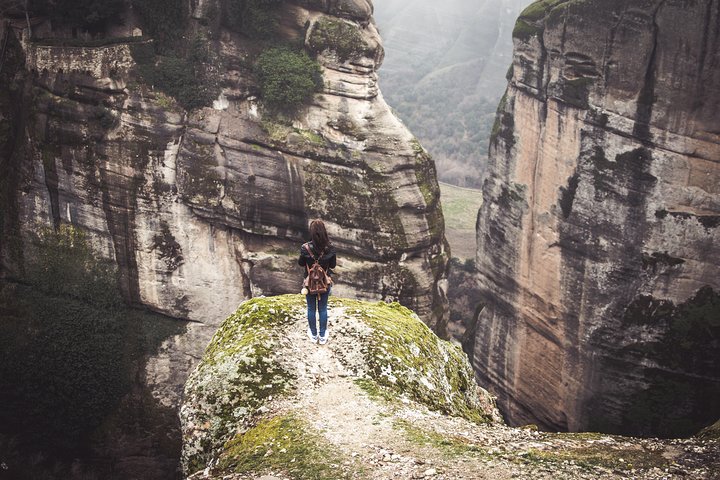

Embark on a 6-day comprehensive tour of Greece’s religious and historical sites. Visit Thermopylae, Meteora, Delphi, Olympia, Mycenae, Nafplio, Epidaurus, Ancient Corinth, Ancient Diolkos, and the Corinth Canal.
Embark on a 6-day comprehensive tour of Greece’s religious and historical sites. Visit Thermopylae, Meteora, Delphi, Olympia, Mycenae, Nafplio, Epidaurus, Ancient Corinth, Ancient Diolkos, and the Corinth Canal.
Thermopylae - Meteora
Thermopylae - Thermopylae is a historic location in Greece known for its narrow coastal passage in ancient times. The Battle of Thermopylae was a significant conflict between a coalition of Greek city-states, led by King Leonidas of Sparta, and the Persian Empire under Xerxes.
The Gates of Fire: Named after the hot sulfur…
Thermopylae - Meteora
Thermopylae - Thermopylae is a historic location in Greece known for its narrow coastal passage in ancient times. The Battle of Thermopylae was a significant conflict between a coalition of Greek city-states, led by King Leonidas of Sparta, and the Persian Empire under Xerxes.
The Gates of Fire: Named after the hot sulfur springs and, in Greek mythology, the entrances to Hades.
The monument of King Leonidas: Built in 1955 by sculptor Vasos Falireas, this impressive brass sculpture depicts the Spartan King with his spear and shield.
Thermopylae museum: This innovative museum is dedicated to the pivotal 480 BC battle that influenced Greek history and Western civilization.
Hotsprings: The baths of Thermopylae are a haven of healing spas. These high-end hydrotherapy facilities focus on balneotherapy, not only for treating specific ailments but also for enhancing general well-being. Of the 60 pending springs, 34 have been officially recognized.
Drive to Meteora
Check in at your selected hotel in Meteora
Meteora - Explore the “Hanging Monasteries” (1 to 2 monasteries).
The town of Kalambaka.
The village of Kastraki.
Witness the stunning Meteora sunset.
Enjoy a late lunch or early dinner at a traditional taverna.
Browse the village shops for handmade souvenirs for family and friends.
Overnight stay in Kalambaka or Kastraki.
Meteora
Meteora - Breakfast in Meteora
Visit the remaining “Hanging Monasteries”
The monasteries to visit include:
St Nicolaos
Rousanou
Varlaam
Metamorphosis Sotiros (Grand Monastery)
St Trinity
St Stefanos
Lunch at a traditional Greek taverna in Kalambaka or Kastraki
Coffees
Drive to Delphi
Check in at Delphi
Option for dinner at Arachova
Overnight stay in Delphi
Delphi
Delphi - Breakfast in Delphi
Delphi, also known as Pytho, is renowned for its ancient sanctuary, which became wealthy as the seat of Pythia, the oracle consulted for major decisions in the classical world. The Greeks considered Delphi the center of the world, symbolized by the Omphalos of Delphi.
Visit the Delphi archaeological site: A UNESCO World Heritage Center, Delphi is one of Greece’s most significant archaeological sites. The oracle’s functions expanded over time to include athletic games and cultural events, notably the Pythian games. The Temple of Apollo, the Ancient Theater, the Stadium, the Athenian Treasury, the Gymnasium, and the Sanctuary of Athena Pronaia are captivating.
Visit the Delphi Archaeological Museum: Home to many important ancient Greek artifacts from Delphi excavations.
Frieze of the Treasury of Sifnias
Naxian Sphinx: Dating to 560 BC, this is one of the earliest artistic representations of the mythical creature with a lion’s body, bird’s wings, and a woman’s head.
Metopes of the Athenian Treasury: From the early 5th century BCE, featuring Theseus and Antiope, Theseus and the Minotaur, Theseus and the Marathonian bull, Heracles and the cattle of Geryon, Heracles battling the three-bodied giant Geryon, Heracles subduing a Centaur, Heracles and Cycnus, Heracles and the Nemean lion, an Amazonomachy scene, and more.
Omphalos: Signifying the earth’s center, kept in Apollo’s temple.
Kleobis and Biton: Statues of two brothers from Argos, typical kouros type, attributed to a Peloponnesian workshop, dating to the late 7th century BC.
Statue of Antinoos: Celebrated for his beauty and youth, and as Emperor Hadrian’s favorite, this statue is a fine example of the neoclassical style revived in the 2nd century AD.
The famous Charioteer: Part of a statuary complex of a chariot drawn by four horses, including a second male figure.
Delphi Village: A popular tourist destination with many hotels, guesthouses, tavernas, and bars.
Enjoy lunch on the Caldera at Delphi, overlooking the stunning Itea and Amfissa.
Shopping for family and friends
Coffees
Drive to Olympia.
Check in at your selected hotel
Option for dinner at “La Belle Helene” with delicious home-cooked Greek meals
Overnight stay in Olympia
Ancient Olympia - Nafplio
Olympia - Breakfast in Olympia
Olympia is an ancient site on Greece’s Peloponnese peninsula, known for hosting the original Olympic Games founded in the 8th century BC. Its extensive ruins include athletic training areas, a stadium, and temples dedicated to the gods Hera and Zeus.
Visit the Temple of Zeus: Dedicated to Zeus, this Doric temple, built in the second quarter of the 5th century BCE, is a model of the classical Greek temple of the Doric order.
Temple of Hera: Known as Heraion, this ancient Archaic Greek temple was dedicated to Hera, queen of the Greek gods. Built around 590 BCE, the Olympic flame is lit in its ruins by Apollo in modern times.
Philippeion: The only circular building inside the Altis, dedicated to Zeus by Philip II of Macedonia after his victory at Chaironeia in 338 BCE. Completed by his son Alexander the Great.
The Hippodrome and later Stadium: The Hippodrome was a wide, flat area with a pole marking the start and finish lines. Horse and chariot races took place here.
The Palaestra: Built in the 3rd century BC as part of the gymnasium complex, it was used for boxing, wrestling, and jumping practice.
The Workshop of Pheidias: Where the great sculptor crafted the gigantic chryselephantine statue of Zeus, one of the Seven Wonders of the ancient world.
The Archaeological Museum of Olympia: Exhibits incredible artifacts from the site.
Statue of Zeus: A giant seated figure about 13 m tall. The huge ivory and gold statue was larger than that of Athena in the Parthenon.
The Museum of the History of the Olympic Games in Antiquity: Since 2004, a new museum based on Georgios Papastefanou’s collection, promoting the Olympic Idea and Education.
The museum of Archimedes (Mathematician): Dedicated to one of the leading scientists in classical antiquity, this unique museum in ancient Olympia showcases replicas of his inventions.
Olympia village: Located in the western Peloponnese, in the beautiful Alpheios river valley, this village offers a serene atmosphere.
“La Belle Helene” meeting wonderful Konstantina, enjoying her delicious authentic Greek home-cooked meals
Browse the village shops for handmade souvenirs for family and friends.
Drive to Nafplio
Check in at your selected hotel
Overnight stay in Nafplio
Nafplio - A charming seaport town in the Peloponnese with a spectacular waterfront, cobblestone streets, and historic buildings, crowned by the Palamidi and Bourtzi fortresses. It was the first capital of the modern Hellenic Republic after the 1821 War of Independence.
Palamidi Castle: Situated on a 216 m high hill, this Venetian fortress offers an impressive view over the Argolic gulf. Climb the 999 steps to the top if you dare!
Freedom Square: An obelisk here thanks the French for their contribution to the War of Independence against the Ottomans, depicting a French and a Hellenic woman in their struggle for Liberty.
Bourtzi: The water castle of Bourtzi is a Venetian fortress located in the harbor’s center.
Constitution Square: The most important and historic square in Nafplio, named after the Constitution granted by Otto, the first king of Greece, after the 1843 uprising.
First Hellenic Parliament: Near Syntagma square, this imposing mosque, built in 1730, housed the first Hellenic parliament from 1825 to 1826.
Anastasios of Nafplia church: Located in the old town, the church’s dome and wall paintings are impressive, showcasing Christian Orthodox religious pragmatism.
St. Spyridon church: The site of one of the darkest events in modern Greek history, the assassination of Ioannis Kapodistrias, the first Greek Governor, in 1831.
Lunch at one of the many unique traditional tavernas
Antica Gelateria di Roma for the best gelato and Italian delights
Pergamonto for the best ‘loukoumades’ in Greece (puff balls with honey or chocolate and almond nuts)
Browse the town’s shops for handmade souvenirs for family and friends.
Epidaurus - Mycenae
Epidaurus - Breakfast in Nafplio
Visit the breathtaking Palamidi fortress…Acronafplia / Arvanitia
Drive to Epidaurus
One of Greece’s most popular archaeological sites, located on the NE side of the Peloponnese in Argolis.
The Epidaurus amphitheater: Renowned for its classic Greek construction and remarkable acoustics. Enjoy theatrical performances by Euripides, Sophocles, Aristophanes, and Aeschylus. A pin or coin dropped on the stage can be heard even from the last seats.
The Epidaurus Archaeological Museum: Known for its temple reconstructions and inscribed columns.
The Asclepius: A sanctuary dedicated to the ancient Greek demi-god of medicine, Asclepius. A remarkable ancient medical retreat.
Drive to Mycenae
Mycenae - Visit Mycenae
Rich in gold, King Agamemnon’s mythical kingdom is celebrated in Homer’s epics. It is the most important and affluent center of the late Bronze Age.
The Lions Gate: The main entrance of the Bronze Age citadel of Mycenae, built in the 13th century BC.
Grave Circles A and B: Royal cemeteries located south of the Lion Gate and outside the Bronze Age citadel.
The Cyclopean Walls: Made of huge limestone boulders, these walls are said to have been built by the mythical Cyclopes.
The Royal Palace: Includes domestic apartments, the Throne Room Suite, the Grand Staircase, rooms for officers or palace officials, and the Forecourt.
The Treasury of Atreus: A large tholos or beehive tomb constructed around 1250 BC.
Tomb of Clytemnestra: A Mycenaean tholos-type tomb built in 1250 BC, named after Clytemnestra, the wife of King Agamemnon.
The Mycenaean Archaeological Museum: Exhibits the most important Mycenaean artifacts, including gold grave goods, burial masks, jewelry, weapons, worship idols, and frescoes.
Drive to Ancient Corinth
Check in at your selected hotel
Late lunch or early dinner at an authentic Greek taverna on a terrace overlooking the Temple of Apollo
Overnight stay in Ancient Corinth or Loutraki
Ancient Corinth - Acrocorinth - Isthmus Canal
Acrocorinth - Visit Acrocorinth, the acropolis of ancient Corinth, a monolithic rock overseeing the ancient city. It is one of the most impressive and dominant acropoleis in the Peloponnese.
Gates: A system of three circuit walls reinforced by towers.
Keep
Peirene Spring: Located within the encircling walls, a gift from Asopus to Sisyphus.
Temple of Aphrodite: Traces of the temple are found on the mountain’s highest peak.
Frankish Tower: At the SW edge of the rock, fortified during Frankish times, forming the fortress’s inner keep. Remains of churches, mosques, houses, fountains, and cisterns are preserved here.
Views of Geraneia Mountain: Enjoy breathtaking views of the Corinthian gulf and the SW coast of the Peloponnese.
Drive to Ancient Corinth
Corinth - Hadgimoustafa spring: A fountain built during the Ottoman Empire.
Ancient Corinth Archaeological Museum: Houses a large collection of artifacts from the local site and smaller sites in the area.
Temple of Apollo: One of the earliest Doric temples in the Peloponnese and Greek mainland, with monolithic columns, built around 560 BCE.
Agora: A rectangular construction 160 m long and 70 m wide, featuring central shops, small temples, an altar, and the renowned podium or Bema, where Apostle Paul addressed the Corinthians in 52 AD.
Roman buildings.
Bema or Pedestal
Theatre and Odeon/Asklepieion
Lechaion road: Leading to the port of Lechaion, facing the Corinthian gulf.
St. Paul’s church: Admire a magnificent mosaic mural depicting Saul’s vision from Christ as he traveled to Damascus to persecute Christians.
Browse the village shops for handmade souvenirs for family and friends.
Drive to Ancient Diolkos, witnessing the ancient passageway from Periander’s time (tyranny)
Drive to Isthmus Canal
Corinth Canal - Visit the Isthmus Canal, a significant 19th-century engineering masterpiece that plays a crucial role in Mediterranean trade.
Drive to Kechries Port, tracing the footsteps of St Paul
Lunch by the Saronic sea at the village of the Baths of Helen of Troy
Return to Athens
Athens - Return to your selected Hotel, Airbnb, or apartment in Athens

- Fully Private Multi Day Tour
- Transportation by private luxury vehicle
- Professional Tour Drivers with in-depth knowledge of Greek history
- English speaking and multi-lingual drivers
- Hotel/Port pick-up and drop-off service
- Skip-the-line tickets (on-request)
- On-board WiFi
- Fresh handmade Greek biscuits
- Bottled water & refreshing wipes
- Fully Private Multi Day Tour
- Transportation by private luxury vehicle
- Professional Tour Drivers with in-depth knowledge of Greek history
- English speaking and multi-lingual drivers
- Hotel/Port pick-up and drop-off service
- Skip-the-line tickets (on-request)
- On-board WiFi
- Fresh handmade Greek biscuits
- Bottled water & refreshing wipes
- 5 nights accommodation (option for hotel reservation upon request)
- Entrance fees to the sites
- Food and drinks
- Airport pick-up and drop-off (additional cost)
- Licensed tour guide to accompany guests into the site and museum (additional cost on request)
- 5 nights accommodation (option for hotel reservation upon request)
- Entrance fees to the sites
- Food and drinks
- Airport pick-up and drop-off (additional cost)
- Licensed tour guide to accompany guests into the site and museum (additional cost on request)
Our journey begins at the historic site of Thermopylae! Here, we honor King Leonidas of Sparta and his 300 Spartan warriors by visiting the captivating monument of his statue.
Next, we head to the breathtaking Meteora! Known as one of the most stunning regions of mainland Greece, Meteora’s hanging monasteries are among the country’s most unique…
Our journey begins at the historic site of Thermopylae! Here, we honor King Leonidas of Sparta and his 300 Spartan warriors by visiting the captivating monument of his statue.
Next, we head to the breathtaking Meteora! Known as one of the most stunning regions of mainland Greece, Meteora’s hanging monasteries are among the country’s most unique attractions.
At the base of Mount Parnassos lies the Pan-Hellenic sanctuary of Delphi, renowned as the most famous oracle of ancient Greece. Delphi was considered the “navel” of the world.
Ancient Olympia in Greece was the venue for the ancient Olympic Games, celebrated every four years by the Greeks.
Mycenae, the kingdom of Agamemnon, is a UNESCO World Heritage Site discovered by H. Schliemann. According to Homer’s epics, the expedition to Troy began here.
Nafplio was the first capital city of modern Greece. This picturesque town, with its Venetian architecture, was once referred to by the Venetians as the Naples of Greece.
The magnificent Epidaurus theater, constructed in the late 4th century BC, was designed to host religious events in honor of the god Asclepius. It is renowned for its symmetry and is uniquely preserved, allowing it to still be in use today.
We will explore the incredible archaeological site of Ancient Corinth, featuring a fabulous museum, courtyard, temple of Apollo, fountain of Glauke, Sacred Spring, Peirene, Asklepieion, Odeion, Bema, Agora, and much more.
At Ancient Diolkos, discover and explore the ancient passage from the Corinthian to the Saronic Gulf and the subducting bridge.
Finally, appreciate the engineering marvel and stunning views of the Corinthian and Saronic gulfs at the Isthmus/Corinth Canal.
- A dress code is required to enter places of worship and selected museums. No shorts or sleeveless tops allowed. Knees and shoulders MUST be covered for both men and women. You may risk refused entry if you fail to comply with these dress requirements
- Animals or pets allowed
- Confirmation will be received at time of booking
- Infant seats are available on request if advised at time of booking
For a full refund, cancel at least 24 hours before the scheduled departure time.
For a full refund, cancel at least 24 hours before the scheduled departure time.


