
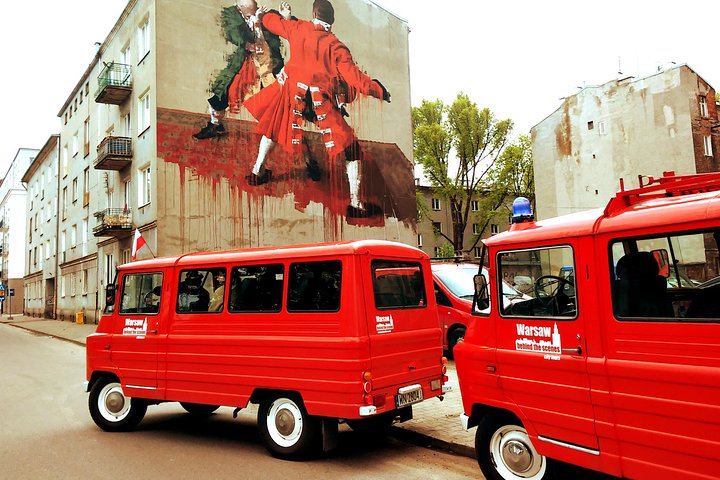


Experience the authentic and lesser-known parts of Warsaw’s history on a small group tour in a retro minibus. Explore WWII sites, communist-era projects, and the city’s transformation in the last 30 years.
Experience the authentic and lesser-known parts of Warsaw’s history on a small group tour in a retro minibus. Explore WWII sites, communist-era projects, and the city’s transformation in the last 30 years.
- Warsaw - After being picked up from the hotel, participants will meet their guide and start with a brief introduction to Warsaw and Poland. This concise historical overview provides crucial context and explains how historical events have influenced the city as it stands today.
- Muranów - The first significant stop is Muranów, a district…
- Warsaw - After being picked up from the hotel, participants will meet their guide and start with a brief introduction to Warsaw and Poland. This concise historical overview provides crucial context and explains how historical events have influenced the city as it stands today.
- Muranów - The first significant stop is Muranów, a district constructed on the former site of the Jewish Ghetto established by Nazi Germany in 1940. While it may appear as a typical postwar residential area, the ground beneath holds a much more dramatic history. With the guide, participants will uncover remnants of the ghetto and learn about the district’s destruction and subsequent reconstruction.
- Chlodna Street - At the junction of Chłodna and Żelazna Streets, visitors will see the site of the iconic wooden ghetto bridge, featured in the film The Pianist. Once elevated above the street, the bridge allowed traffic to pass below while connecting two isolated sections of the ghetto. Through historical photographs, the guide will help visualize how this area once appeared and functioned.
- Nowolipki - Participants will then learn about the Warsaw Ghetto Uprising of 1943, when Jewish resistance fighters made a final stand against deportation. After weeks of combat, the ghetto was completely destroyed. The guide will explain how these tragic events are commemorated and how history is interwoven into the modern cityscape.
- Bielańska - The narrative continues with the broader context of World War II and Poland’s political future. Agreements between the Western Allies and Stalin placed Poland under Soviet control. The Warsaw Uprising of 1944 was the city’s last attempt to alter that outcome. Following its failure, Nazi forces systematically demolished approximately 85% of Warsaw. The Red Army entered the abandoned ruins in January 1945.
- Praga Polnoc - Next, cross the Vistula River to reach Praga, one of Warsaw’s most unique districts. Enjoy views of the riverbank before exploring an area that largely survived the war intact. Praga retains the ambiance of prewar Warsaw, with Belle Époque architecture, traditional courtyards, and a strong local identity. Once overlooked, it is now one of the city’s most creative neighborhoods, still largely untouched by mass tourism.
- Śródmieście - Returning to central Warsaw, stop near the former Polish Communist Party headquarters. Learn how the communist authorities faced the challenge of rebuilding a devastated capital after 1945. Architects aimed to create a modern and functional city, but their designs had to align with Soviet-inspired ideological requirements. As participants explore the area, they will see the results of these compromises firsthand.
- Warsaw - The tour concludes with the events of 1989, when the Solidarity movement and Pope John Paul II were instrumental in ending communist rule in Poland. Entering a new era of democracy and capitalism, Warsaw experienced yet another significant transformation. By the end of the tour, participants will have a deeper understanding of how the city’s past and present are connected—and how its complex history continues to shape modern Warsaw.

- Professional local guide
- Communist retro minibus ‘Żuk
- Professional local guide
- Communist retro minibus ‘Żuk
This tour provides a more profound and genuine exploration of Warsaw compared to typical sightseeing tours. Traveling in a vintage communist-era Żuk minibus adds historical significance and allows entry into areas often overlooked by larger tour groups. With an intimate group setting, participants will discover lesser-known neighborhoods, listen to…
This tour provides a more profound and genuine exploration of Warsaw compared to typical sightseeing tours. Traveling in a vintage communist-era Żuk minibus adds historical significance and allows entry into areas often overlooked by larger tour groups. With an intimate group setting, participants will discover lesser-known neighborhoods, listen to personal anecdotes, and gain insights into how Warsaw was devastated, rebuilt, and evolved over the past century. Instead of solely highlighting landmarks, the tour weaves together places with compelling stories—from the Jewish Ghetto and wartime uprisings to communist-era urban planning and contemporary Warsaw—offering a comprehensive understanding of the city’s intricate identity.
- The minimum number of people required to launch the tour is 2. A solitary traveller may join the tour if there is another booking for at least 2 people.
- This tour can be booked instantly online for adults and children over 150 cm (4 ft 9 in). If you wish to book the tour for a child under 150 cm, please contact the tour operator in advance to check the availability of seat boosters, which are mandatory under Polish law.
- Each minibus accommodates up to 8 passengers, and a fleet of 5 minibuses is available.
- The vehicles are used primarily for transfers between locations, with walking segments at each stop. Please wear comfortable clothing and suitable footwear.
- Please note that classic vintage minibuses are not equipped with air conditioning, and some do not have seat belts (which is permitted for historic vehicles). All vehicles are equipped with heating for the winter season.
For a full refund, cancel at least 24 hours before the scheduled departure time.
For a full refund, cancel at least 24 hours before the scheduled departure time.


