

Embark on a 4-day private tour of Busan, Gyeongju, and Geoje Island to discover the rich history, vibrant culture, and breathtaking natural beauty of South Korea. Explore ancient tombs, visit filming locations, and indulge in local cuisine on this unforgettable journey.
Embark on a 4-day private tour of Busan, Gyeongju, and Geoje Island to discover the rich history, vibrant culture, and breathtaking natural beauty of South Korea. Explore ancient tombs, visit filming locations, and indulge in local cuisine on this unforgettable journey.
Pick up at Busan / Gyeongju - Busan Hotel check-in or Gyeongju Hotel overnight
Haedong Yonggungsa Temple, Busan - Located on the northeastern coast of Busan, Haedong Yonggungsa Temple is a unique attraction as it is one of the few temples in Korea situated by the sea, with most others nestled in the mountains. Established in 1376 by the esteemed…
Pick up at Busan / Gyeongju - Busan Hotel check-in or Gyeongju Hotel overnight
Haedong Yonggungsa Temple, Busan - Located on the northeastern coast of Busan, Haedong Yonggungsa Temple is a unique attraction as it is one of the few temples in Korea situated by the sea, with most others nestled in the mountains. Established in 1376 by the esteemed Buddhist teacher Naong during the Goryeo dynasty, the temple features the Seawater Great Goddess Buddha, the Daeungjeon Main Sanctuary, the Yongwangdang Shrine, the Gulbeop Buddhist Sanctum (housed in a cave), and a three-story pagoda with four lions overlooking the ocean. Many visitors come here on New Year’s Day to make wishes as they watch the sunrise. April is particularly beautiful with cherry blossoms in full bloom. The temple is illuminated with lanterns during the celebration of Buddha’s birth in the fourth month of the lunar calendar, offering a stunning night view.
Daebyeon Port Entrance - Daebyeon Port is recognized as one of the 100 beautiful fishing villages by the Ministry of Oceans and Fisheries and is known for its anchovy festival. Anchovies, a specialty of Gijang, swim in large schools. The Anchovy Theme Square, the festival’s main venue, features iconic towers and stunning sculptures enhanced by lighting, music, and fountains. Visitors can also enjoy abalone porridge with fresh seafood and shop for dried seafood.
Haeundae Dalmaji-gil Road - Often referred to as Busan’s Montmartre, Dalmaji-gil Road is renowned for its breathtaking views of the blue ocean, white sandy beach, Camellia forest, and pine tree forest, making it one of Busan’s eight scenic sites. Haeundae Dalmaji Hill and the moon viewed from Cheongsapo add to the area’s enchanting atmosphere.
Songjeong Beach - Songjeong Beach extends for 1.2 kilometers with a width of 30 to 60 meters. Its white sandy beach is perfect for families with young children due to its shallow waters. The beach is a popular spot for pre-wedding photoshoots. Nearby, there are many restaurants serving hoe (sliced raw fish). Jukdo Park, located north of the beach at the entrance to Songjeonghang Port, features white and red lighthouses that are popular photo spots, as well as views of the beach from Songiljeong Pavilion at the peak of Jukdo Park. The path leads through a grove of evergreens, and fishermen often line the breakwaters to the lighthouses.
Haeundae Beach - Haeundae Beach is Busan’s most famous beach. The white sand stretches for about 1.5 kilometers over a 30- to 50-meter wide area, creating a stunning coastline before a shallow bay, ideal for swimming. Every summer, people flock to Haeundae Beach. The area around the beach offers a range of accommodations from luxury hotels to private guesthouses, making it an ideal summer vacation destination. Haeundae Beach is also known for various cultural events and festivals throughout the year. Other attractions in the area include Dongbaekseom Island, Busan Aquarium, a yachting dock, BEXCO, driving courses, and more.
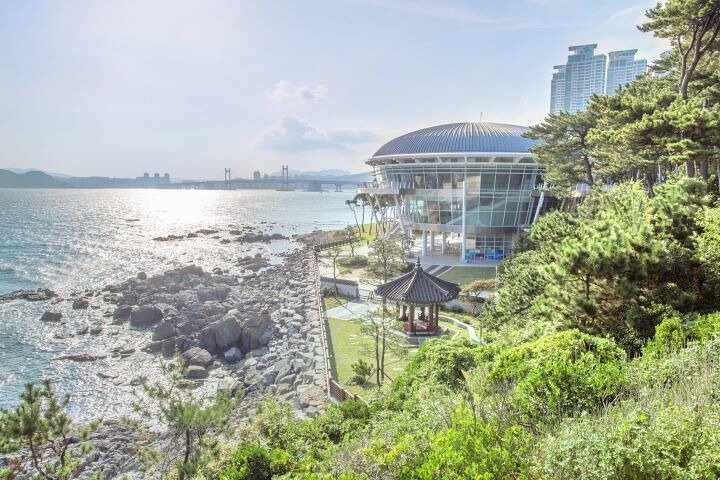
Dongbaekseom - Situated on Dongbaekseom Island, known for its beautiful natural landscape with dense camellia and pine trees, Nurimaru APEC House has served as a memorial hall and a prestigious international conference venue since the APEC summit meeting. Nurimaru, a three-story building, is a modernistic interpretation of “jeongja,” a traditional Korean pavilion. Its roof design symbolizes the ridgeline of Dongbaekseom Island. The interior showcases Korea’s creative traditional culture. The terrace, designed with a Korean wooden floor concept, offers views of Oryukdo Island, Gwangan Bridge, and Dallmaji Hill. Located near Haeundae Beach, it provides a spectacular view of the beach and serves as a reputable international conference hall blending modern and natural beauty.
Shinsegae Centum City - Shinsegae Centum City Department Store holds the Guinness World Record as the largest shopping complex globally, offering a wide range of entertainment options, including an ice rink, movie theater, golf range, and spa. The store features 21 designer brands and 622 renowned brands. As Korea’s first department store, Shinsegae reflects decades of retail experience in this flagship location. Designed by globally acclaimed experts like Italian architect Claudio Silvestrin and American architecture and design firm Callison, Centum City was developed under the concept of a “golden sea.” The department store has become a defining landmark in Busan.
UN Memorial Cemetery in Korea - The UN Memorial Cemetery in Korea honors UN soldiers from 16 countries and UN aids from five countries who were killed in battle during the Korean War from 1950-1953. It is the only memorial cemetery in the world dedicated to UN soldiers. Initially, the cemetery held up to 11,000 graves, but most of the fallen soldiers were repatriated at their families’ request, leaving only 2,300 graves. The serene park spans a grassy plain area of 135,000 square meters. Notable sites and memorials include the Memorial Service Hall, Memorabilia Hall, two Turkish Monuments, Greek Monument, Australian Monument, British Commonwealth Monument, and two ponds.
Oryukdo Skywalk - Oryukdo Island comprises Usakdo Island, Surido Island, Gonggotdo Island, Guldo Island, and Deungdaedo (Lighthouse) Island. The upper part of Usakdo divides into two segments, leading to the island sometimes being called Bangpaedo Island and Sol Island, depending on the water level. As many ships pass by Oryukdo Island en route to Busan Port, it serves as a symbol of Busan’s cultural heritage. Oryukdo Skywalk is located at Seungdumal, meaning a saddle, due to the shape of the point. It was also known as Jallokgae by local residents and female divers.
Geoje Island Oedo Botania Garden - Busan Hotel check-in (All itineraries, flexible move or customized plan)
Geoga Grand Bridge - The “Geoga undersea tunnel and bridge” project began in early 2004, creating an 8.2km motorway between Busan, Korea’s southernmost, second-largest city, and Geoje Island. This four-lane fixed link includes a 4km immersed tunnel and two 2km cable-stayed bridges. The immersed tunnel is expected to be one of the longest in the world, especially in a seismically active area. “Geoga Bridge,” opened on December 13, 2010, shortens the travel distance between Geoje Island and Busan by linking Gadeok Island, part of Busan, and Geoje Island, Korea’s second-largest island after Jeju. The route reduces the travel distance between the two destinations from 140 kilometers to 60 kilometers, allowing drivers to travel between them in 50 minutes, compared to about 130 minutes previously.
Hakdong Mongdol Beach - Hakdong Mongdol Beach, covered with small black pebbles, spans 1.2 kilometers in length and 50 meters in width, covering a 30,000 ㎡ area. Walking on the pebbles stimulates acupressure points on the feet, offering health benefits to visitors. Unlike other beaches in the southern region, Hakdong Mongdol Beach has deep waters and rough waves, but various water activities are available. Nearby accommodations and restaurants are available, and the dock at the beach offers boat excursions around popular attractions.
Windy Hill - On the way to Haegeumgang Village, visitors may encounter the fishing village of Dojangpo. On the left side of the village is Dojangpo Wharf, where one can take a tour ferry to Oedo Island and Haegeumgang River. Overlooking the sea, a hill covered in grass is known as Windy Hill. The location gained popularity after being used as a filming site for popular Korean dramas such as “Eve’s Garden (2003)” and “Merry-Go-Round (2004).” The name “Windy Hill” was given by fans who visited the island. Walking toward the hill along the wooden promenade from the wharf, one can see Hakdong Village from a distance.
Sinseondae - Sinseondae Cliff
Sinseondae Observatory, located between Dojangpo Maeul and Haegeumgang, offers stunning views of fantastically shaped rocks against the deep-blue ocean hues. “Sinseon” in Korean means supernatural beings; the beauty of this spot is said to attract such beings to frolic. The blue and yellow colors layered in the rocks tell a unique history of the terrain. A stairway from the road leads directly to the lookout point. Just past a gas station along the coastal highway, Sinseondae Observatory reveals itself. Walking out onto the rocks of Sinseondae, views of the surrounding islands and incredible landscape open up to viewers. Many commercials and TV shows have been filmed here, taking advantage of this amazing setting. April and May are the perfect times to see the bright-yellow canola flowers across the island.
Gyeongju - Busan Hotel check-in (All itineraries, flexible move or customized plan)
Bulguksa Temple - Bulguksa is a Buddhist temple complex featuring a series of wooden buildings on raised stone terraces. The grounds are divided into three areas: Birojeon (the Vairocana Buddha Hall), Daeungjeon (the Hall of Great Enlightenment), and Geungnakjeon (the Hall of Supreme Bliss). These areas and the stone terraces were designed to represent the land of Buddha. The stone terraces, bridges, and the two pagodas – Seokgatap (Pagoda of Sakyamuni) and Dabotap (Pagoda of Bountiful Treasures) – facing the Daeungjeon showcase the fine masonry work of the Silla.
Daereungwon Tomb Complex - The Daereungwon Tomb Complex in Gyeongju features large ancient tombs of kings and nobles from the Silla Kingdom. There are twenty-three large tombs here; 13 have been excavated, but only one (Cheonmachong - tomb of King Michu) is open to the public. The tomb chamber contained a lacquered wooden coffin with burial goods placed around it. A total of 11,500 artifacts were recovered from the tomb, illustrating the king’s lavish lifestyle. The tomb was excavated in 1973 and is believed to date back to the fifth century.
Gyeongju Folk Craft Village - Gyeongju Folk Craft Village consists of 40 thatched and tile-roofed houses inhabited by local artisans skilled in traditional arts and crafts. Various crafts, including metal, pottery, timber, jewels, hanbok (Korean traditional clothes), and stone crafts, can be found in the village.
Gyeongju Gyochon Traditional Village - At Gyeongju Gyochon Village, visitors can explore the House of the Gyeongju Choi Clan (Important Folklore Material No. 27) and sample Gyeongju Gyodong Beopju Liquor (Important Intangible Cultural Asset No. 86-3). The village centers around the Gyeongju Choi Clan, a family known for maintaining their wealth over 12 generations and producing many notable individuals. Visitors can learn about the lifestyle and spending habits that enabled the family to achieve this. The village is also home to the site of Yoseokgung, the house of Silla Princess Yoseok. Nearby attractions include Gyerim Forest, Naemulwangneung Royal Tomb, and Gyeongjuhyanggyo Local Confucian School.
Gyeongju National Museum - Gyeongju National Museum is cherished by visitors and residents alike for housing numerous historical and cultural artifacts from the Silla dynasty (57 BC - AD 935). The museum recently underwent renovation, dividing into an art gallery, historical artifacts exhibition hall, Wolji Pond exhibition hall, and a planned exhibition space. In addition to enhancing visitor facilities, Gyeongju National Museum is committed to contributing to the community and reestablishing its identity as a museum by providing lifelong learning opportunities and improving management. As a significant cultural center, the museum strives to preserve, exhibit, and research the rich history and culture of Silla while aiming to become a cultural multi-complex center by promoting international exchange opportunities, social education programs, and a variety of special exhibitions.
Cheomseongdae Observatory - Cheomseongdae is the oldest existing astronomical observatory in Asia. Constructed during the reign of Queen Seon-deok (r. 632-647), it was used to observe stars to forecast the weather. This stone structure is a beautiful combination of straight lines and curves and was designated as National Treasure No.31 on December 20th, 1962. It stands 9.17m high, and the base stone on each side measures 5.35m. The Vernal Equinox, Autumnal Equinox, Winter Solstice, Summer Solstice, and the 24 solar terms (also known as the astronomical solar year) were determined by observing stars. The pavilion stone is believed to have been used as a standard for determining directions: north, south, east, and west. The 362 stones used to build Cheomseongdae represented the 362 days in a lunar year.
Bomun Lake - Bomun Tourist Complex is Gyeongju’s international tourist district, centered around Bomunho Lake, located about 10 kilometers east of downtown Gyeongju. The area spans approximately 8,000 km² and features an international-scale luxurious hotel, family-friendly condos, a golf range, and pleasant walking paths designed to meet the diverse needs of tourists. The tourist complex attracts crowds in April when cherry blossoms are in full bloom. The sight of cherry blossoms around Bomunho Lake and Bulguksa Temple is popular even among domestic travelers.
Donggung Palace and Wolji Pond - Anamji Pond
Gyeongju Donggung Palace and Wolji Pond served as a secondary palace for the crown prince of the Silla Kingdom and as a banquet site for important national events and visitors. The pond was created in 674 during King Munmu’s reign and features three small islands and a landscape of 12 small hills to the northeast. After Silla’s fall, the site was abandoned and forgotten. The pond was referred to as “Anapji” during the Goryeo and Joseon periods. In the 1980s, a pottery fragment with the letters “Wolji” (a pond that reflects the moon) was discovered, revealing the pond’s true name. Following this discovery, the site was renamed Donggung Palace and Wolji Pond.
After the tour, return to Busan for a night tour.
Busan Hotel check-in or drop-off at KTX train station / airport (PUS) (All itineraries, flexible move or customized plan)
Songdo Beach - Opened in 1913, Songdo Beach is Korea’s first beach. After its golden era in the 1960s and 1970s, the beach became deserted. Efforts to restore its former beauty have made it even more stunning than in its heyday. With its pristine sandy beach, clear water, cloud trails, and an overwater cable car, Songdo Beach is once again a popular tourist destination, attracting over five million visitors annually. Enjoy spectacular coastal views of Songdo Beach from a scenic marine cable car ride. See the vast waters, cliffs, and rock formations. Opt for the transparent crystal cabin to view Yannan Park, Nampodong City, and Namhwang Bridge.
Busan Gamcheon Culture Village - Gamcheon Culture Village is characterized by houses built in a staircase fashion on the foothills of a coastal mountain, earning it the nickname “Machu Picchu of Busan.” The alleys throughout this community are vibrantly decorated with murals and sculptures created by the residents.
Gwangbok-ro Fashion Street - Nampodong, the old downtown area of Busan, offers a wide variety of brand shops and affordable local stores. Between the streets, there are street food alleys.
Gukje Market - Originally formed by Korean War refugees, Gukje Market has grown into Busan’s largest downtown market. Here, visitors can find the best wholesale prices for clothing, silk, linen, curtains, bags, glasses, and many imported items. Similar to Namdaemun Market in Seoul, the stores are small, and the vendor-filled alleys are narrow. Gukje Market spills out into the streets and continues into Kwangbok-dong & Namp’o-dong. Along its southern boundary is the Jagalchi Fish Market.
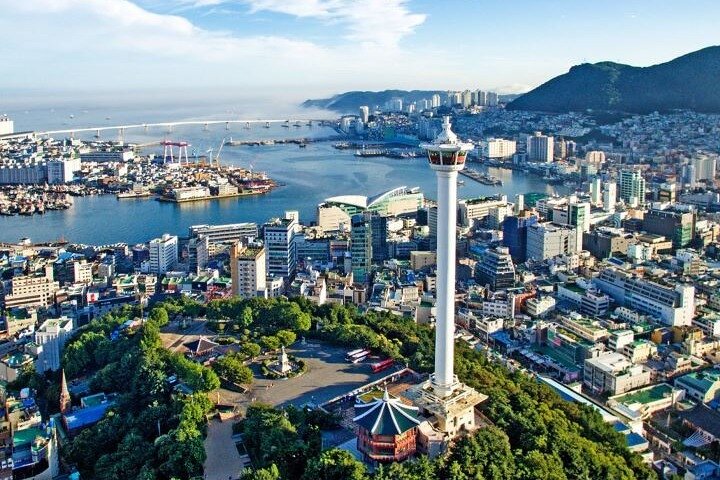
Busan Tower - Busan Tower is a symbol of Busan, standing proudly at 69 meters above sea level with a height of 120 meters. The top of the tower is modeled after the baldaquin of Dabotap Pagoda in Bulguksa Temple, Gyeongju. Loved by Busan citizens and tourists alike, the tower offers a stunning night view and features such as the Statue of the Great Admiral Yi Sun-sin, the Bell of the Citizens, a flower clock, and a bust of the Busan-based independent activist, Baeksan An Hee-je.
Jagalchi Market - Jagalchi Fish Market is a renowned market representing Busan and is famous nationwide. Visitors can enjoy fresh raw fish right at the market. Even today, visitors can see women selling mackerel, sea squirts (ascidians), and other seafood on wooden boxes along the road outside the market and along the shore.
Gwangalli Beach - Gwangalli Beach is 1.4 km long and 25~110 m wide, known for its fine sand. The area has undergone a water cleaning program, resulting in pristine waters that attract many young tourists. In addition to the beachfront, the Gwangalli area is filled with romantic restaurants and cafes, as well as stores selling famous fashion brands. The area offers plenty to do, but many people visit in the evening to enjoy the bright lights of Gwangandaegyo Bridge stretching across the horizon.

- Private transportation
- Guide + driver or driving guide
- Busan, Sin-Gyeongju KTX train station pick-up or drop-off
- Gas + toll + parking fees
- Entrance fees, if you skip or decide to go to places, please pay yourself on the spot
- Busan airport pick-up or drop-off ( PUS )
- Private transportation
- Guide + driver or driving guide
- Busan, Sin-Gyeongju KTX train station pick-up or drop-off
- Gas + toll + parking fees
- Entrance fees, if you skip or decide to go to places, please pay yourself on the spot
- Busan airport pick-up or drop-off ( PUS )
- Meals
- Hotel, Airbnb, Accommodation
- Entrance fees
- Meals
- Hotel, Airbnb, Accommodation
- Entrance fees
From ancient times to the present, Busan has been a city of natural beauty, where mountains, sea, and rivers harmonize to create a wonderful landscape and a center of transportation and trade hub.
To the east of the surrounding city, you can see the splendid Buddhist culture of the Silla Kingdom in Gyeongju, the 1000-year-old capital of the Silla…
From ancient times to the present, Busan has been a city of natural beauty, where mountains, sea, and rivers harmonize to create a wonderful landscape and a center of transportation and trade hub.
To the east of the surrounding city, you can see the splendid Buddhist culture of the Silla Kingdom in Gyeongju, the 1000-year-old capital of the Silla Kingdom, and learn about the lifestyle and philosophy of ancient Koreans through the tombs of the Silla kings and nobles.
Geoje Island is the second-largest island in Korea after Jeju Island. we will take a cruise to visit the Botanical Garden, a filming location for famous movies and TV shows, and then see a Korean War POW camp history.
It can be a memorable trip by booking a hotel in Busan without the hassle of lodging while visiting interesting stories and attractions from local guides in nearby cities and enjoying the abundant culture, history, scenery, and various famous local foodies for 4 days on your customized private trip.
For a full refund, cancel at least 24 hours before the scheduled departure time.
For a full refund, cancel at least 24 hours before the scheduled departure time.